Nine Days in the West Bank: The Issue of Israel’s Settlements

Above Image: Taken on the day I visited the Al Jalazoun Refugee Camp, which houses about 15,000 refugees. It is one of 19 such camps in the West Bank.The camp is right on the edge of an Israeli settlement. This picture gives a sense of how close they are, as the fenced wall to the right in the foreground is the wall of a refugee school for boys, while the Israeli settlement homes are in the background. Unsurprisingly, it is often a site of hostilities.

———-

I recently had the opportunity (along with four other U.S. academics) to participate in an Education and Cultural Exchange Mission to the West Bank and Israel from July 22-30. The trip was made possible by the efforts of a colleague, Dr. Justin Bateh, a Palestinian-American born in the U.S., that I got to know while at a conference in Chicago, who connected me with the the program through the American Federation of Ramallah-Palestine. The purpose of the trip was to gain first hand experience with some of the key issues that influence Israeli-Palestinian relations and current conditions in the West Bank as they relate to Israeli (and sometimes U.S.) policy.  

It was an extraordinarily eye-opening experience, that included meetings with the Mayors of Ramallah, Bethlehem, and other smaller towns, the Palestinian Authority’s Minister of Education, the leaders of important NGOs working in the region, various Palestinian university officials and professors, and a member of the Israeli Knesset (Israel’s unicameral parliament). In addition to all of the famed holy sites, we also visited a refugee camp, a Bedouin community, some of the more troubled towns like Hebron, and interacted with everyday Palestinians who, of course, had a lot to tell us about their experiences. Continue reading

My Sabbatical: The Year in Review

Image above: Standing on the walls of Acre (“Akko”) in northern Israel, July 2016.

Over the next week or two, I will be turning my thoughts to the coming semester, with classes starting soon. I am happy to be getting back to teaching, as I generally enjoy it very much (my occasional complaints on Facebook aside), but I am also grateful to Florida State College at Jacksonville for granting me a twelve-month sabbatical over the past year, which I have tried to make as productive as possible. While many academics are familiar with the sabbatical process, I have learned few of my friends outside academia, or even many graduate students, understand it. Since I also assume I will need to account for my time spent during the sabbatical during a future evaluation for the college, I want to reflect here on the topic, how it works, and what I was able to accomplish as a result of it. Particularly in light of some of the good spirited teasing I have received from old friends (non-academics) worried about how their tax dollars were being spent as a result.

Continue reading

The State of Crusade Studies: An Interview with Dr. Helen J. Nicholson

Among modern crusade historians, few are as respected as Helen J. Nicholson. Indeed, as Professor of Medieval History at Cardiff University, where she has taught for more than twenty years and served as the head of the Department of History from 2012-2015, Helen has established herself among the top tier of the world’s crusade historians through no less than twenty-one books she has authored or edited on the crusades or the military orders. In addition, she has also authored nearly seventy scholarly articles or essays in peer reviewed journals or edited volumes and has served on review committees for numerous academic presses or journals. This is all in addition to her often active participation and leadership in many scholarly societies to include, of course, the Society for the Study of the Crusades and the Latin East.

Helen certainly has an academic background that would have suggested she was primed for success as a crusade historian early in her career. From 1979–82 she studied at the prestigious Oxford University, where she earned her BA in Ancient and Medieval History (1st class hons.), which she then converted to a MA in 1986. Then, from 1986 to 1989, she worked on her doctorate at the University of Leicester under the direction of the renowned crusade historian Norman Housley. She continued to teach part time at Leicester until transitioning into her position at Cardiff University in 1994 where she has remained until the present. Continue reading

The Current Status of the Islamic State’s “Caliphate”

Map: Situation as of June 29th, 2016. The grey area represents the territories effectively under the control of the Islamic State (source).

A July 12th report in the Washington Post by Joby Warrick and Souad Mekhennet has caused a stir recently for suggesting that the Islamic State’s “caliphate” is on the ropes. Titled “Inside ISIS: Quietly Preparing for the Loss of the ‘Caliphate,” the story has received a lot of attention on cable news and has been widely (and in some cases, enthusiastically) shared online. Indeed, I have been asked to comment on the topic in an interview for a local television station on Saturday morning, but I assume the topics considered during the interview will now, unfortunately, expand to include discussion of the terrorist attack killing 84 people in Nice (and wounding over 200) that took place on July 14th. Yet here I want to focus on the claims of the Washington Post article and think through the issue a bit.  Continue reading

Gregory VII: Call for a “Crusade”, 1074

Image: Engraving of Pope Gregory VII saying mass from Little Pictorial Lives of the Saints (1878).

Provided below are English and Latin accounts of Pope Gregory VII’s calling of a sort of proto-crusade as early as 1074. Although this venture never materialized, it is interesting to note that only three years after the events of Manzikert there was serious advocacy of providing major Western military aid to Eastern Christians by the papacy. Yet it never got off the ground due to the distractions and problems Gregory VII had to deal with as a result the Investiture Controversy. Continue reading

Criticism of Crusading After the Second Crusade

N.B. What follows is a brief essay/collection of quotations from Christian sources considering criticism of crusading in the wake of the failure of the Second Crusade. The success of the First Crusade had stifled such criticism, but the failure of the Second Crusade, led by Europe’s most important monarchs, led to soul searching about the cause of the failure, as well as finger pointing. This was originally written in 2005 for an old crusades website I used to run (e.g. “crusades-encyclopedia) while I was an ambitious M.A. graduate student at the University of North Florida. The website is no longer online, but I plan to resurrect it, in a more polished form, at some point in the future. But for now, this may be useful for those searching the web for information on this topic or as a link to supplementary reading for a crusades course, so I include it here in its original form.

————-

The Search for Answers

Since Urban II’s calling of the First Crusade, popes and preachers had promised crusaders that they acted with divine sanction and that God would grant them significant spiritual rewards for their efforts. Pope Eugenius III and his preachers used the same formula in their preaching of the Second Crusade, announcing that those willing to take the cross would win no less than the full remission of their sins. Thousands responded to Eugenius III’s call and headed for the Holy Land confident of God’s support. Few were prepared for the disastrous events that followed, which witnessed the nearly total destruction of King Conrad III’s army and the ignoble withdrawal of King Louis VII’s forces. Once the demoralizing results of the crusade became known, disillusioned Christians began to seek answers for the failure of warriors whom, as they had been assured by their priests, fought on God’s behalf. It was not long before the search for answers turned to criticism of nearly all involved with the crusade.  Continue reading

Islamic Law and Homosexuality: An Interview with Theologian Arnold Yasin Mol

Since the slaughter of 49 Americans at a gay club in Orlando on June 12, there has been a lot of discussion about the motives of the killer, Omar Mateen. The 29-year-old killer had a long history of religious extremism dating back to his high school years, when he was sent home for cheering the attacks of 9/11. In 2010, he reportedly declared his desire to become a martyr and later was investigated for extremism by the FBI twice. The first investigation was in 2013 when his co-workers reported him for advocating extremist causes, and then again in 2014 for his close connections with a man at his mosque who fled the United States for Syria to become a suicide bomber for the Islamic State. He also reportedly became a fan of the Islamic State’s beheading videos, watching them online and talking about them with others.

During the massacre the killer made a number of statements to 911 operators and on social media where he explained his actions. In one case, during the attack, he told 911 operators that he carried out these acts on behalf of the Islamic State, declaring his allegiance to the group’s leader. Survivors of the massacre also said that he told 911 operators he was doing it because the U.S. was “bombing my country.” By this, he meant Afghanistan. Although the killer was an American citizen, born in the U.S. to Afghan parents, he apparently did not view the U.S. as his country. Instead, reflecting the views of his Taliban supporting father, he apparently saw Afghanistan as his true homeland.  Also among the many reported comments of the killer, one seems to explain his choice of victims. In the moments before he shot over 100 patrons of a gay bar in Florida, killing 49, he wrote on Facebook “The real muslims [sic] will never accept the filthy ways of the west…” Continue reading

Few Warning Signs of Radicalization?

I just read the following NPR piece titled “Orlando Shooter Update: Few Warning Signs Point to Radicalization.”

This is stunning. “Few Warning Signs” of radicalization?

According to reports from his past coworkers and school-mates:

1. He was sent home in high school for celebrating the 9/11 attacks.
2. He grew up under the influence of a father that was a supporter of the Taliban.
3. In 2007 he became so unhinged at a party when a piece of pork touched his hamburger that he threatened to kill everyone.
4. In 2010 he declared his desire to become a martyr.
5. In 2013 he was investigated by the FBI for his extremist rhetoric.
6. In 2014 he was again investigated by the FBI for his ties to an extremist he knew from his mosque that had joined the Islamic State.

7. He got his kicks from watching Islamic State beheading videos and later telling his coworkers about them.

8. He declared his support for the Islamic State during the attacks, declaring it revenge for bombing “his country” (by this he meant Afghanistan) and said true Muslims would never accept “the filthy ways of the west” before shooting over 100 people at a gay bar, killing 49 of them.

[Update: In addition, in 2014 Mateen also became a devotee of the radical preacher Anwar al-Awlaki, whose lectures had inspired other radicals to commit acts of terrorism.]

In light of such a past, it hardly seems surprising that he declared his support and allegiance to the Islamic State as he carried out his slaughter. What surprises me is the effort to pretend all of this is not somehow related to his actions in Orlando. Other factors such as mental health, homophobia, etc… most likely played a part in this, but to deny also the radicalization aspect in this seems itself a form of denial. It is also a dangerous one, particularly if it means we refuse to factor in or downplay the threat of the global jihadist movement (led by the Islamic State) and its massive online propaganda machine (which has demonstrated its effectiveness in motivating others on many occasions). Indeed, Mateen, is precisely the type of person they hope to target with their efforts, even if they never have direct contact. Today the DOJ even released only partial transcripts of the killer’s conversations with the police during the massacre, scrubbing the killer’s extremist views and omitting his pledged allegiance to the Islamic State [Edit: See addendum].

What else did Mateen need to add to his resume to be considered as having shown “warning signs” of radicalization?

He seems to have checked every box.

He even called the police and posted on Facebook to make his motivations and intentions as clear as possible, after a long history of personal connections with extremism, yet we refuse to believe him.

———-

Continue reading

Marcus Bull on the Religious Appeal of Crusading


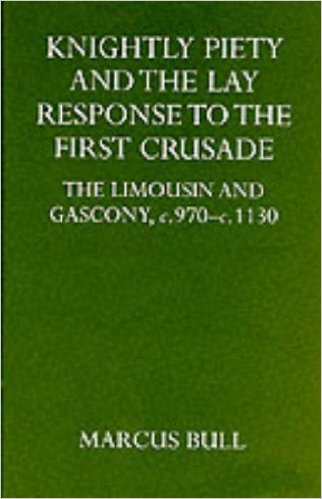
As a follow up to a recent post on the scholarship of retired Cambridge University scholar Jonathan Riley-Smith, I also wanted to highlight (briefly) the work of UNC-Chapel Hill professor Marcus Bull (formerly at the University of Bristol), another influential crusade historian that has made an important argument concerning the religious roots of the crusading movement. With a focus on religious and social history, Bull has (like Riley-Smith) convincingly emphasized the religious appeal of crusading to knights in an important essay and book- both published in 1993.[1]In these works, Bull refuted the long held Erdmann thesis, which argued that the rise of the crusading movement could be explained by papal schemes, inspired by the Peace and Truce of God movements, to simply export violent and rowdy trouble making knights to the Holy Land, thereby restoring peace at home and securing the resurgent papacy’s political power in Europe.[2] Bull takes a different approach as he notes that where the Erdmann approach is most “open to criticism is in its emphasis upon the priorities of a small number of important prelates, canonists and theologians,” to the exclusion of the overwhelming majority of those who actually went on the crusade.[3]

Continue reading

Jonathan Riley-Smith on the Motivations of the First Crusaders

See also: https://apholt.com/2017/07/28/the-most-influential-crusade-historians/

In any consideration of historians’ arguments about the appeal of the First Crusade  to the earliest crusaders (as well as the circumstances by which it came about), Jonathan Riley-Smith must be front and center. No other scholar has had as much of an impact on the field of crusade studies over the past forty years than the now retired Cambridge University historian. Indeed, it is not an understatement to note that Riley-Smith, as the author of more than a dozen influential books and many influential essays, has revolutionized the modern historiography of the crusades. This was accomplished not only through his many important publications, but also the many doctoral students he taught at Cambridge who are now also professors at various institutions in North America and Europe that reflect his influence.  His influence is also reflected in his role as a founder of the Society for the Study of the Crusades in the Latin East, the world’s leading scholarly society for the study of the crusades.  Continue reading