Yearly Archives: 2015

The Future of Medieval History: An Interview with Dr. Alfred J. Andrea

“Retired” scholar Alfred J. Andrea is easily one of the most active and dynamic historians I know. As an accomplished author, editor, and Professor Emeritus of Medieval History at the University of Vermont, you might think he would take it easy in his retirement. Yet those who know Al know better. The 73-year-old former U.S. Marine still looks the part, Continue reading

Learning to Live with ISIS? -The One-Year Anniversary of the “Islamic State.”

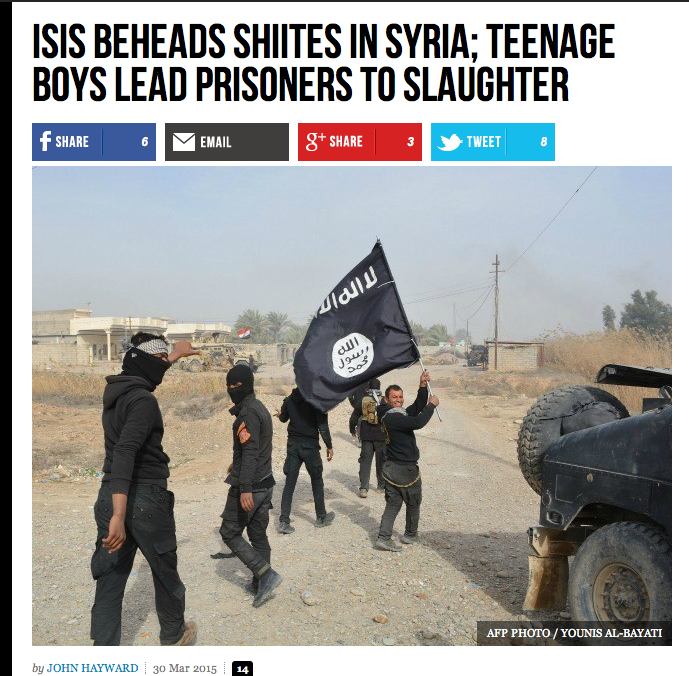
It was around this time last year that the “Islamic State of Iraq and Syria,” which currently refers to itself as the “Islamic State,” emerged out of the ongoing Syrian conflict to invade and extend its rule from Syria into northern Iraq. Since then, ISIS has carried out a high number of atrocities against anyone that did not adhere to their views of Islamic religious orthodoxy or morality. Their often-gruesome actions and appalling ideological views have brought an extraordinary amount of media attention. Indeed, in the last twelve months, I alone have been called on to give no less than 27 television or radio interviews on topics related to ISIS for local media in the Jacksonville area. Thus, like many other Americans, I have watched the evolution of the organization very carefully over the past year. Now, a year after ISIS first emerged on the scene, I am have far greater concerns about the group’s staying power and potential for growth.

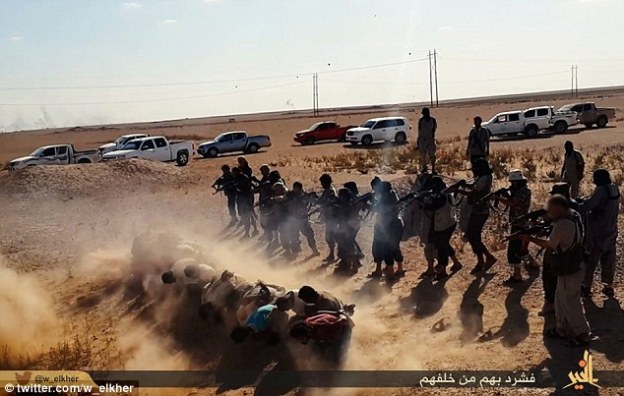
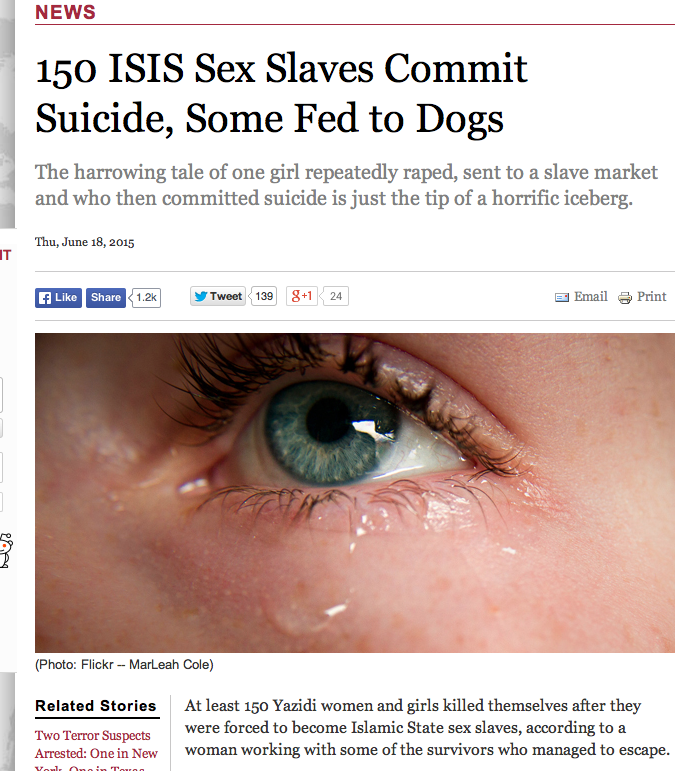
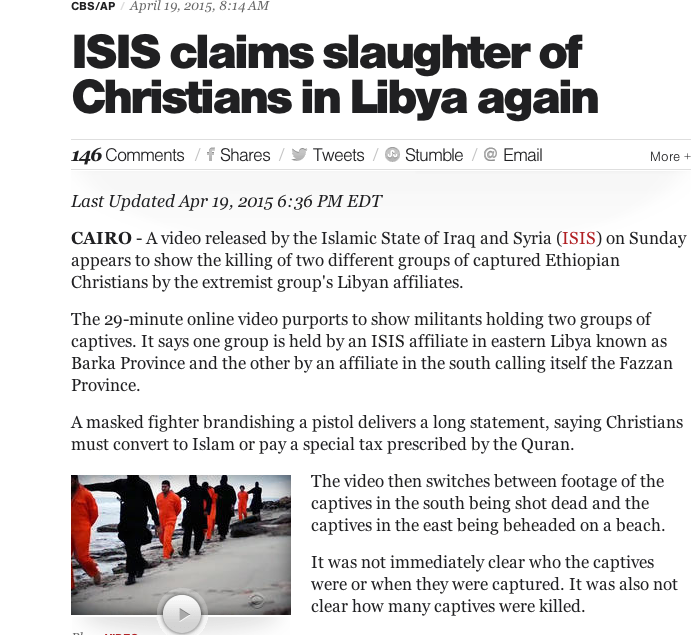
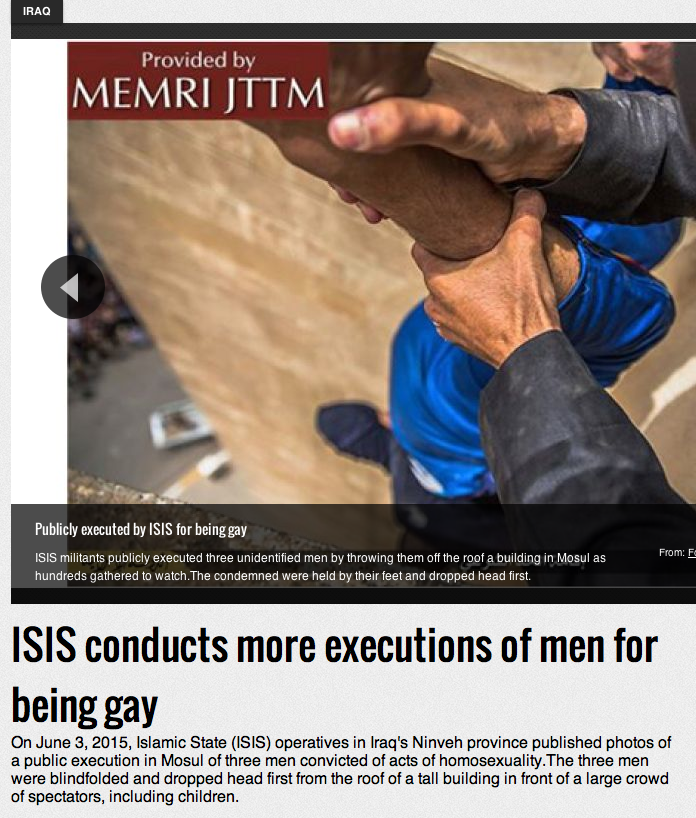
As has been well documented on video and by numerous eyewitness accounts, their catalogue of abuses include the sexual enslavement of thousands of very young Yazidi girls, the public beheading and humiliation of Christians, and the execution of homosexuals by throwing them from the roofs of tall buildings. Yet, in terms of total numbers, it is their fellow Muslims, primarily Shia, who have suffered the most under their rule.

Screen shot 2015-06-19 at 11.55.16 PMScreen shot 2015-06-19 at 11.57.27 PMScreen shot 2015-06-19 at 11.59.12 PMScreen shot 2015-06-20 at 12.00.58 AM Continue reading

“Thou shalt not kill” vs. “Thou shalt not murder”

When I lecture on the First Crusade in my courses at Florida State College at Jacksonville, I occasionally get a question from one of my students along the lines of “How could Christians do this?”

They ask because, as modern Christians with a post-Enlightenment understanding of their faith, they find the idea of God- or Jesus more specifically- supporting warfare to be troubling. Such students tend to associate New Testament Christianity with peace as Jesus himself famously called on others to turn the other cheek when confronted with violence. Often, in such cases, students will cite the biblical commandment “Thou shalt not kill” (Exodus 20:13) as a proof-text supporting their assumptions that medieval Christians who participated in the crusades simply did not understand the Bible.

I find I often have to restrain myself a bit when I respond. Not because I am upset with the student, of course, but because I feel tempted to cover too much in my response. There are a number of assumptions here that are either demonstrably false or (at the least) highly debatable, but among the most significant, perhaps, is the idea that Exodus 20:13 represents a biblical injunction against “killing.” There are two major problems with this assumption. Continue reading

Guest Essay: The Four-Minute Expert by Dr. David Schwam-Baird

UNF Political Science Professor Dr. David Schwam-Baird is a regular go to source for local media in the Jacksonville area on all things political. He has given numerous television interviews on topics ranging from domestic political affairs to complex matters of diplomacy in the Middle East. He is also a former professor of mine, so when I first began to do my own local media interviews on similarly complex topics I naturally turned to David for advice.

After all, the prospect of appearing on television to coherently and thoughtfully discuss an enormously complex topic like Middle East violence in a short three to four minute interview allowing only 20 to 30 second responses to the interviewer’s questions is a much more daunting task than one might think. Particularly for someone who has never done it before. Indeed, I recall once being asked, at the end of such an interview dealing with the rise of ISIS, how do we “bring peace to the Middle East.”

I had about 15 seconds to respond.

There was no time for a nuanced discussion of the long term consequences of the Sunni-Shia divide, western imperialism, modern misunderstandings of historic relations between East and West in the Islamic world (e.g. the crusades),  the issues that emerged from the founding of the modern state of Israel in 1948, or a whole host of other long term issues, much less the short term issues related more narrowly to the rise of ISIS in the summer of 2014.

Nope.

Just 15 seconds.

Continue reading

Historians on Susan Jacoby’s New York Times Essay on the First Crusade

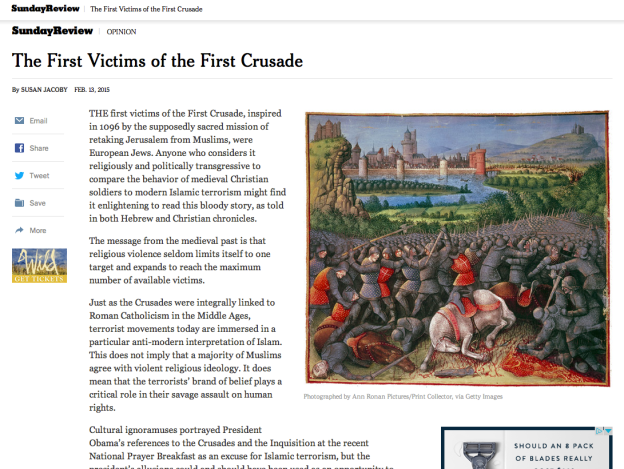
In defense of President Obama, who had recently been criticized for his comparison of the medieval crusaders to modern Islamic terrorists (see my response here), the New York Times published an essay on Friday (“The First Victims of the First Crusade”) by Susan Jacoby. Her essay highlighted the brutal attack on Jews during the First Crusade and, once again, equated the crusaders with modern Islamic terrorists. She wrote, “Anyone who considers it religiously and politically transgressive to compare the behavior of medieval Christian soldiers to modern Islamic terrorism might find it enlightening to read this bloody story.” She then described the horrors of the slaughter and compared it with the killing of religious minorities recently carried out by ISIS in the Middle East.

Jacoby then ended her piece with an odd celebration of the virtues of the post-Enlightenment West. In it, she contrasted the medieval Christian past with the modern post-Enlightenment western world, arguing that groups like ISIS “offer a ghastly and ghostly reminder of what the Western world might look like had there never been religious reformations, the Enlightenment and, above all, the separation of church and state.”

Jacoby’s comments, particularly those contrasting the medieval and modern west, caused a stir among medieval historians, much of it negative.

Continue reading

Soldier, Scholar, Politician: An Interview with Dr. Wayne Bowen

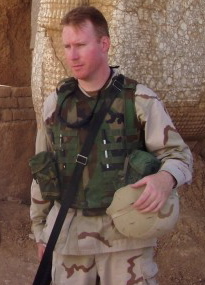
Although Dr. Wayne Bowen is an accomplished author, professor, and Chair of the Department of History at Southeast Missouri State University, he does not look or act like what one might expect from a history professor. He is physically fit, has close-cropped hair, and carries himself with an obvious military bearing, all of which is undoubtedly a product of his many years as an officer in the U.S. Army Reserve. Indeed, Wayne is a veteran of deployments to both Bosnia and Iraq, and has risen to the rank of Lt. Col. Perhaps equally as interesting, he has also recently embarked on a successful career as an elected politician, currently serving as a city councilman in his hometown of Cape Girardeau, Mo. Moreover, he has done so unapologetically as a Republican, which is a rarity among academics in the humanities.

OLYMPUS DIGITAL CAMERA

Continue reading

President Obama, ISIS, and the Crusades

Since President Obama’s controversial speech at the National Prayer Breakfast on Feb 5th, during which he compared the medieval crusades (as a form of religious extremism) with the religious extremism of modern terrorist groups like the ISIS, crusades historians have been busy writing a number of pieces that address the issue. Medieval historian Dan Franke has given a comprehensive overview (with links) of the various debates that have taken place. I’d suggest that those unfamiliar with these arguments and discussions start by reading his overview provided here.

Although a bit late to the party, I have also offered my two-cents on the issue in an guest column published by the Florida Times-Union. See Guest Column: Crusades were a Reaction to Islamic Militarism– Florida Times-Union.

A selection from that column is provided below.

——————-

“Significantly, it was in large part because of a period of heightened threat to Christians in the East during the late 11th Century that the First Crusade was called, as Muslim armies had recently conquered much of once Christian Anatolia.

For more than 20 years, Byzantine emperors had been requesting (and sometimes pleading for) military aid from Western Christians until they finally received it in the form of the First Crusade as called by Pope Urban II in 1095.

As retired Cambridge University historian Jonathan Riley-Smith once noted, “The denigrators of the crusades stress their brutality and savagery, which cannot be denied; but they offer no explanation other than the stupidity, barbarism and intolerance of the crusaders, on whom it has become conventional to lay most blame. Yet the original justification for crusading was Muslim aggression…”

This brings us back to Obama’s comments. I found them problematic for reasons cited by Riley-Smith.

The president told critics of modern Islamic violence to get off their “high horse” by citing the crusades as an example of similar Christian violence. Paradoxically the crusades were largely the product of medieval Islamic violence.”

——————-

Edit: Dan Franke continues to keep us updated on the current debate taking place online and in print. Here he links to the most recent articles, including my own, and even an online discussion I had the other night with two medieval historians, David Perry and Paul Halsall, about some of these issues. See Dan’s addendum here and my exchange (on David Perry’s website) with David and Paul here.
The Burning of the Jordanian Pilot and the Legitimacy of the Islamic State’s Caliphate

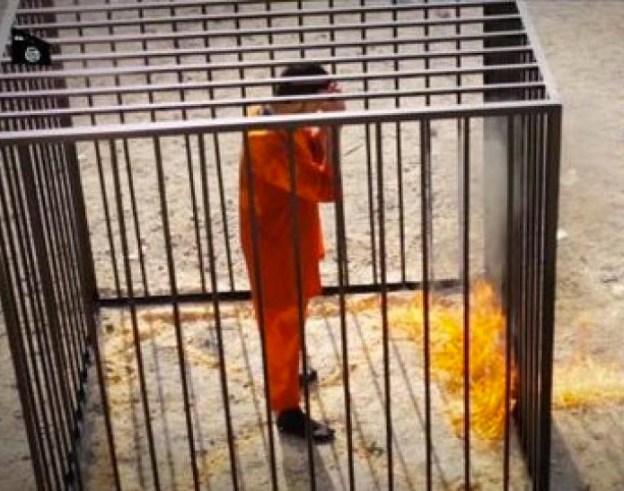
Last Tuesday the Islamic State released a video of their execution of a captured 26-year-old Jordanian pilot. In the gruesome video, they placed the young man in a cage, then lit an accelerant that quickly engulfed him in flames, burning him alive until he was dead. This was brutal even by Islamic State standards, which otherwise regularly beheads its enemies and recently attempted to execute a homosexual by throwing him off of a seven-story building. When they realized the man had survived the fall, they stoned him to death. Yet none of these gruesome executions generated as much condemnation as the video of the young pilot being burned to death.

Condemnation in the West was swift and furious, but it was perhaps even more pronounced in many parts of the Islamic world, as Muslim political and religious leaders condemned the execution as well. Such condemnations ranged from respected and influential Islamic authorities like the Grand Sheikh of Al-Azhar, Ahmed al-Tayeb, to radical and militant leaders from Al Qaeda and the Muslim Brotherhood, who compete with the Islamic State for recruits and legitimacy. See here, here, and here.

Yet the primary stated reason for the intensity of such condemnations had little to do with the death of the pilot, but rather the means by which the pilot died- fire. Continue reading

Will the Real Extremists Stand Up Please?

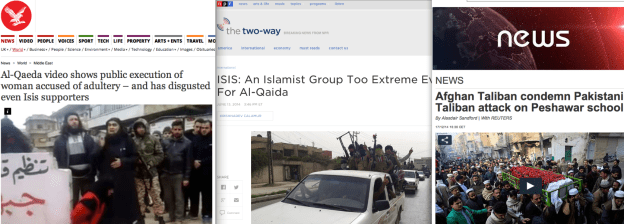
Recently an article in the U.K. Independent came out with the headline “Al-Qaeda video shows public execution of woman accused of adultery – and has disgusted even Isis supporters.”

Previously, it was widely reported that one of the reasons ISIS developed independently from Al-Qaeda was that even Al-Qaeda saw their methods as too extreme– causing division.

Now ISIS is taking shots at Al Qaeda suggesting their methods are too extreme (in this case over something that is relatively minor compared to what ISIS has done).

Add to this the recent condemnation of the Pakistan version of the Taliban’s killing of 130 plus school children as too extreme by the Afghan version of the Taliban and it begins to get a bit ridiculous. Who knows what they all think of their fellow jihadists Boko Haram in Nigeria. They probably nit-pick about their mass killings and public executions as well.

Will the real extremists stand up please?

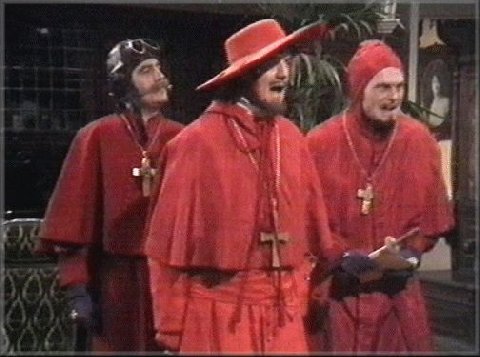
The fact is that they are all extreme, ruthless, and brutal in their methods of course, but perhaps this is a way to try to win points with potential jihadists looking to join an organization that provides the right fit for their extremism since they now have so many choices? With over 18,000 foreign fighters from all over the world drawn to ISIS’s wars in Iraq and Syria and who knows how many foreign recruits drawn to various Ai-Qaeda or Taliban manifestations around the Middle East and Africa, not to mention the apparent appeal of Boko Haram in Nigeria, recruiting must be very competitive in the jihadist world at the moment. This would all be great material for a Monty Python style sketch if the reality was not so serious.