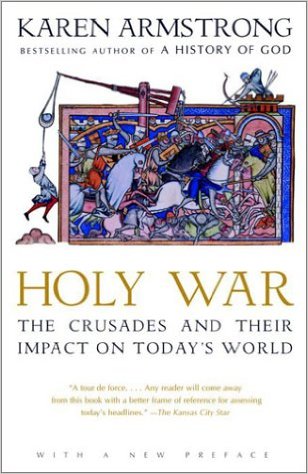
Crusade Historians and Karen Armstrong

Karen Armstrong is a former nun who writes broadly on political and religious issues including the crusades and Islam. As a well known critic of modern western attitudes towards Islam, Armstrong has often sought to draw attention to what she sees as historical injustices carried out by westerners in the East. She lists the crusades among these injustices. For example, in her work, Islam: A Short History, she writes:

It was, for example, during the Crusades, when it was Christians who had instigated a series of brutal holy wars against the Muslim world, that Islam was described by the learned scholar-monks of Europe as an inherently violent and intolerant faith, which had only been able to establish itself by the sword. The myth of the supposed fanatical intolerance of Islam has become one of the received ideas of the West. [pp. 179-180]

Of all of those currently writing on the crusades, her work is probably among the most popular and well known to the general public. In my case, I have had history students who have read her books in other settings come to me confused about apparent contradictions between what they were learning in my class and what they read in her book. I also once had a member of the general public, after reading a guest column I once wrote for the Florida Times Union, email me for the same reason, seeking clarification. The reason for these contradictions is because I have been trained as a medieval historian and work within the current dominant historiography of the crusades, much of which is decidedly at odds with some of the claims Armstrong makes in her works.
Continue reading

Hair, Beards, Clothing, and Masculinity in Early Christianity

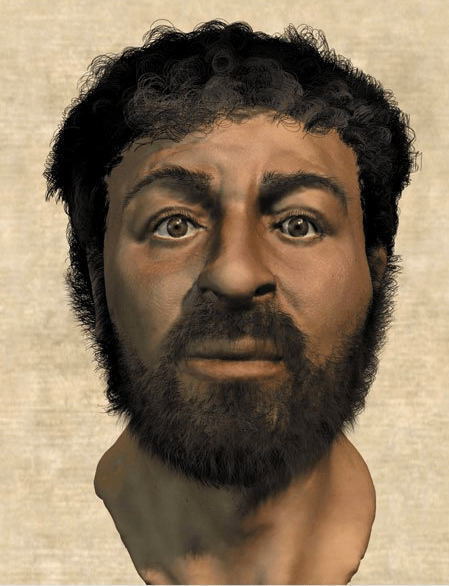
Above Image:This is an image of Jesus created by a CGI model in 2001 suggesting that Jesus’s skin color would have been darker and more olive-colored than his traditional depictions in Western art. Note also his short hair, in contrast to common modern depictions of a long haired Jesus, which is likely accurate in light of general Hebrew and Christian condemnations of long hair on men during the first century.

Something a bit different here, but what follows is a brief selection from a much lengthier chapter of my dissertation that looked at warrior manliness and crusading. This is taken from an early chapter that considered early Christian views of appropriate hair and dress and how those views later influenced the way medieval clerics judged warriors on the same. 

——————

Many early Christian commentators worried about the effeminization of Christian men on issues related to hair and clothing. Their concerns were primarily over the abilities of men, who had adopted hair and clothing styles that were perceived as feminine, to remain strong in an age of persecution. Tertullian, for example, worried that the Christian man who had lost the visible signs of manliness would fail when the virtue of his manhood was challenged by the threat of martyrdom.[1] Thus, for many early Christian writers, it was important to promote a standard of masculine dress and hair that would, in their view, contribute to the manly resolve with which Christian men faced the physical and spiritual dangers of the world. Continue reading

Samuel Huntington’s “Bloody Borders” Revisited

In 1993, in a controversial essay written for Foreign Affairs titled “The Clash of Civilizations,” the influential Harvard University political scientist Samuel P. Huntington (d. 2008) wrote:

“In Eurasia the great historic fault lines between civilizations are once more aflame. This is particularly true along the boundaries of the crescent-shaped Islamic bloc of nations, from the bulge of Africa to central Asia. Violence also occurs between Muslims, on the one hand, and Orthodox Serbs in the Balkans, Jews in Israel, Hindus in India, Buddhists in Burma and Catholics in the Philippines. Islam has bloody borders.”

Samuel Huntington

Samuel Huntington, Harvard University’s Albert J. Weatherhead University Professor. Staff Photo Jon Chase/Harvard University News Office

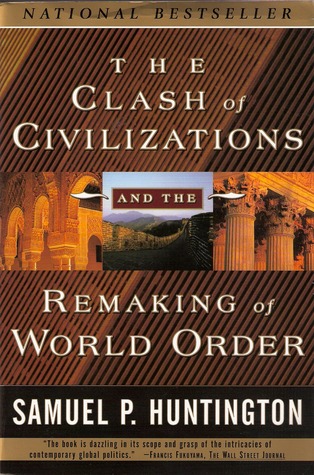
Critics responded swiftly. They argued that Huntington’s claim represented an unfair attack on Islam and refused to take into account other factors (such as economics, for example) beyond simple religious differences. Others rejected his particular definitions of “civilizations.” Nevertheless, a few years later, Huntington defended and stood firmly by his original comments in his 1996 book The Clash of Civilizations and the Remaking of World Order. In it (pages 256-258), he laid out evidence that he argued “was overwhelming” in support of his thesis. He noted that while Muslims make up about one-fifth of the world’s population, “they have been far more involved in intergroup violence than the people of any other civilization.”

For his evidence, he list three primary points. Continue reading

Apology for the Fourth Crusade

Image: Orthodox Ecumenical Patriarch Bartholomew I with Pope John Paul II.

The sack of Constantinople by armies of the Fourth Crusade in 1204 ranks as one of the odder and most lamentable events of the broader medieval crusading movement. This is because Constantinople was the Christian capital city of the Byzantine Empire, obviously an odd target for Christian crusaders. Historians debate the causes of the crusaders straying so far from their original destination of Egypt, whether it can be blamed on duplicitous Venetians, or was instead an accident of history- with one misfortune after another leading the- by then- excommunicated, misguided, and desperate crusaders to Constantinople.

In terms of consequences, some have argued, unconvincingly in my view, that the sack of Constantinople so weakened the Byzantine Empire that it is at least partly responsible for its eventual conquest by the Turks in 1453… more than two centuries later. A lot can happen over two centuries. Others argue the broader crusading movement instead artificially preserved the Byzantine Empire as it was severely threatened by Turkish military expansion into Asia-Minor in the late eleventh century. Turkish aggression prompted the calling of the First Crusade in 1095 which restored control of considerable territories to Byzantine authority (e.g. the city of Nicaea, much of Asia-Minor, etc…). The aggression of Muslim armies was an issue that the Byzantines continued to struggle with from 1095 until the events of 1204 (before and after as well). Thus, the unique circumstances of the crusaders’ conquest of Constantinople in 1204 is (at least in part) a reflection of the pre-existing military and (especially) political weakness of the Byzantine Empire, rather than its cause.

Regardless of the causes or consequences, Continue reading

Martial Arts in the Age of the War on Terror: An Interview with Master Daniel Gimenez

When I was a kid growing up in St. Augustine, I took karate lessons from the great Taekwondo Instructor Ken Durling. Even then, more than thirty years ago, the always kind and soft-spoken Mr. Durling was something of a local legend. I vaguely recall one day before class, sitting huddled with other elementary or middle school aged kids, one of the older kids telling us with great sincerity and enthusiasm of how Mr. Durling had once killed an opponent by punching through his chest, snatching his heart, and showing it to the man before he died. Needless to say, at a young age when I was more willing to entertain stories like that, I was likely a bit quicker in snapping to attention that day and promptly obeying all of Mr. Durling’s commands during class.

I have no idea where this particular myth originated. For all I know, the “showing your opponent his heart before he dies” myth probably began with Bruce Lee or Chuck Norris and then found its way to local heroes or legends like Mr. During, to be endlessly repeated by young students and fans who lionize their indestructible martial arts instructors. The myth itself might be silly, but not the respect that young students have for such instructors. Martial arts instructors are often extraordinarily important role models for kids, who look to them for guidance not only in dealing with a bully, or any sort of dangerous situation, but also more generally in terms of character and discipline.

It was for this reason that almost two years ago I decided to stop in the Karate America martial arts school located off of Solana Road in Ponte Vedra, Florida. Continue reading

Anti-Muslim Sentiment in the United States: My Two Cents

Tonight (April 5, 2016), I will participate in a panel discussion considering, primarily, anti-Muslim sentiment in the United States. The other participants include a Catholic priest, a Rabbi, a historian of 20th century Germany, and former official for the Council on American-Islamic Relations (CAIR). The panel includes a scholar of modern German history and a Rabbi because it considers, in a broader context, the “parallels” of historic anti-Semitism and modern anti-Muslim sentiment, seemingly suggesting that modern American Muslims are experiencing something similar to what German Jews experienced in the 1930s under Hitler. This seems like an odd framework for a panel discussion on anti-Muslim sentiment in the U.S., as my initial thought is to instinctively dismiss the comparison. Nazi Germany and 21st century America? Nevertheless, the prospect of taking part in an important discussion on the topic of anti-Muslim sentiment in the U.S. with such an interesting and informed group makes it well worth enduring the framework for the discussion.

Let me consider (or think through) some related issues more fully below… Continue reading

Al-Azhar and the Islamic State

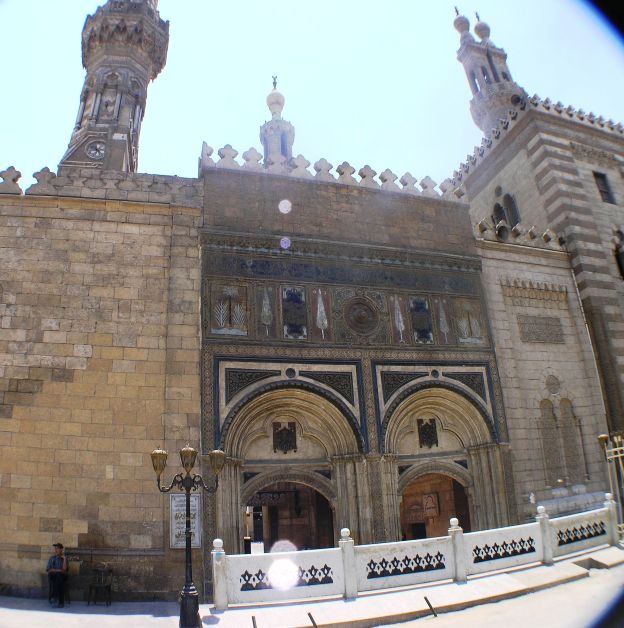
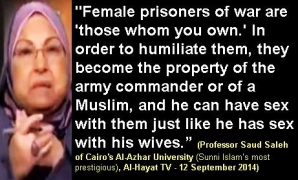
Al-Azhar University is considered Sunni Islam’s oldest and most distinguished institution of learning. The University was founded c. 1171 in Cairo when the Ayyubids under Salah al-Din overthrew the Shia Fatimid Empire in Egypt. The new Sunni rulers insisted that the instruction of Sunni jurisprudence should replace any Shia instruction and the new university would be centered around the Al-Azhar mosque (originally constructed c. 970-972). It was at this point, with the founding of the university c. 1171, that Al-Azhar (and Cairo) began to establish itself as one of the most authoritative Islamic institutions of the past nine-hundred years, remaining so today. Thus, the views of the scholars of Al-Azhar matter to many modern Muslims, particularly in the absence of a modern generally recognized caliphate, who often look to Al-Azhar for guidance on modern controversies. Consequently, I have found Al-Azhar’s commentary on issues related to the rise of the Islamic State (and related issues) troubling. Continue reading

Defending Western Civilization: An Interview with Dr. Rachel Fulton Brown

Although slavery has existed since the “dawn of civilization,” Columbia University historian Eric Foner points out that the modern west was the first to abolish it. This was a result, Foner argues, of a unique blending of evangelical and Enlightenment thought that “placed a new emphasis on every person’s inherent dignity and natural rights….” Princeton historian Bernard Lewis notes that the west then effectively influenced the abolition of slavery in non-western societies as well, leading to the worldwide decline of the institution in the modern era. Similarly, as University of Pennsylvania historian Alan Kors has argued, it was in the west that capitalism (for all its warts and critics) emerged to produce “the greatest alleviation of suffering; the greatest liberation from want, ignorance, and superstition; and the greatest increase of bounty and opportunity in the history of all human life.” Moreover, in terms of women’s rights, no other society has been more open to the concepts of legal and political equality between men and women than the modern west, where women now hold unprecedented liberties and freedoms not found on the same scope or scale in any other past or current society. Indeed, former Clark University Philosophy Professor Christina Hoff Sommers has noted that American women “are among the most liberated and privileged — and safest — people on earth.”

One might think that, in light of such achievements, one would find greater value in the study of western civilization than expressed by many critics calling for its removal from college and university curriculums and general education requirements. Even the Rev. Jesse Jackson, a former contender for the Democratic Presidential nomination, no less, once joined students at Stanford in chanting, “Hey, hey, ho, ho, Western Civ has got to go!”

Many academics who do study western civilization tend to emphasize the worst aspects of it. It’s true, after all, that although slavery and overtly discriminatory laws have been overturned, that racism continues to have an impact on people’s lives and is a worthy subject of study. Similarly, while capitalism has done more to alleviate poverty than any other economic system, there are many who fail to thrive in a capitalist economy and so scholars and economists who seek ways to improve a capitalist society to insure its humanity (hopefully without destroying economic freedom and the potential for economic growth) do noble work. Similarly, while women hold unprecedented legal rights in the western world (the unique birthplace of modern feminism), it took considerable effort to get to this point and there are still many concerns about reaching full equality. Continue reading

The Continuing Importance of the Liberal Arts: An Interview with Dr. Cecilia Gaposchkin

Dartmouth College history professor Cecilia Gaposchkin has had an impressive career as a crusade historian. She is one of the world’s leading historians on the saint and crusading king Louis IX and one of the few crusade historians to hold a tenured position at an elite Ivy League school, the combination of which makes her a leading voice in the field. She is also a respected teacher, known for having a great impact on her students in the classroom. Continue reading

The West, the Muslim World, and Slavery

With the recent institutionalization of slavery in the so-called Islamic State, as well as the troubling and much publicized acknowledgement of the legitimacy of slavery by some modern Islamic scholars (see examples here, here, and here), the issue of slavery in the Muslim world has been on my radar recently.

slaveryslaveryislam

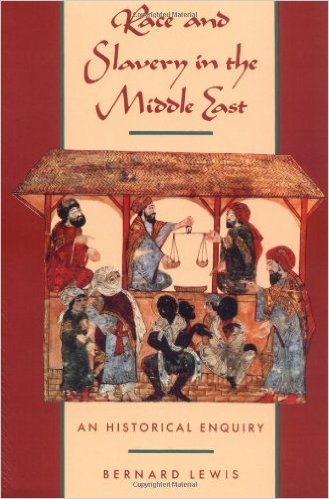
Consequently, some comments by the former Princeton scholar Bernard Lewis on this issue recently caught my attention. In his book Race and Slavery in the Middle East (Oxford University Press, 1990), Lewis wrote: Continue reading