Tag Archives: Alfred J. Andrea

Seven Myths of the Spanish Inquisition: An Interview with Dr. Gretchen Starr-LeBeau

As editors for Hackett Publishing’s Myths of History Series, Alfred J. Andrea and I were quite pleased to have recruited scholar Gretchen Starr-Lebeau to write Seven Myths of the Spanish Inquisition (2023) for the series. Like all of the historical topics covered in the series, many popular myths about the Spanish Inquisition are emphasized in modern literature, film, and the broader popular culture, and have become so imbued in the public consciousness that the efforts of professors to push back against them can seem almost futile. This is why Al and I, as series editors, emphasized the importance of recruiting major scholars, with impeccable credentials, and experienced teachers, with the ability to communicate well with students and general readers, as authors or editors of books in our series. It is for this reason that Al and I were so pleased to have Gretchen, a respected scholar with considerable experience in the college classroom, agree to tackle the challenging topic of the Spanish Inquisition.

Continue reading

The High-Flying Sexy World of Encyclopedia Editing: Some Insights for Potential Encyclopedists

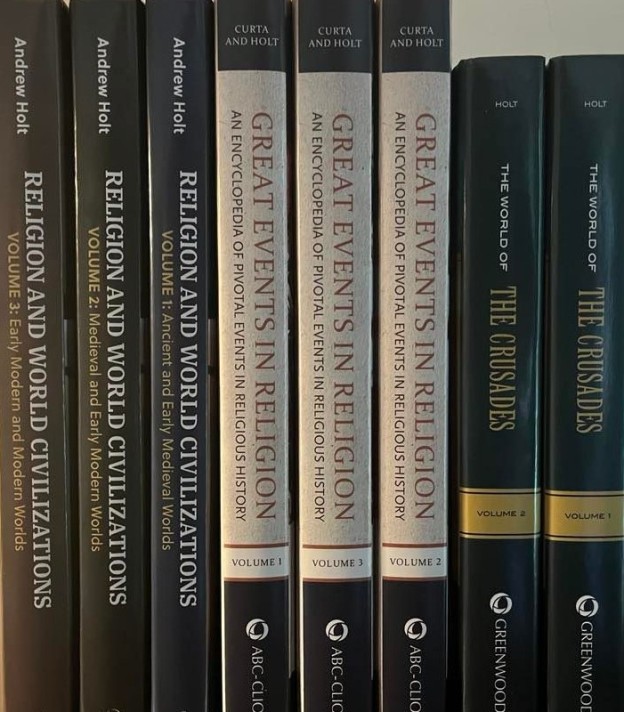
Having recently received hardback copies of a third multivolume encyclopedia that I have either edited or authored, I sometimes get questions about the process. Frankly, there are not a lot of written resources for academics considering taking on such a project for the first time, but you can count on senior scholars to share their wisdom. For example, I was fortunate enough to be able to discuss my various projects with my friend, Alfred J. Andrea, a master encyclopedist, and co-edit my first encyclopedia with my former dissertation advisor, Florin Curta, a leading scholar of the early Middle Ages. In this, I have been fortunate to have such guidance, and so want to share a bit of what I have learned about the process.

It’s important to note that one’s experience editing (or authoring) such a project can vary quite a bit from project to project. It depends on one’s goals from the outset, your level of commitment, the level of support from the publisher, and whether or not there is a global pandemic that shuts down all the universities and makes many of your contributors sick while you are trying to complete the task (yes, it happened). These variables aside, while fully acknowledging that other encyclopedists may disagree with me on some finer points, there are some general considerations that I feel confident sharing here.

In what is surely one of the least exciting possible blog posts with the smallest possible target audience since I began blogging, I reflect on some of those considerations in encyclopedia editing here. Hopefully, they will be of use to those few brave souls considering taking on such a project.

Continue reading

Guest Essay: Santiago Matamoros in the Americas by Alfred J. Andrea

Main Image: Santiago Mataespañois, (Santiago, Killer of Spaniards) Museo das Peregrinacións e de Santiago. Photo by A. J. Andrea.

See also: Guest Essay: Santiago Matamoros by Alfred J. Andrea

———————-

Santiago Matamoros was every bit as much the patron of the Spaniards’ conquests in the Americas as he had been during the preceding four and a half centuries of Iberian Reconquista.  The fact that numerous cities and towns throughout Latin America were blessed with the names “Santiago,” and “Matamoros,” including 27 Santiagos and 16 Matamoroses in Mexico alone, indicates the warrior saint’s importance to the conquistadors and the colonists who followed them. And those numbers do not include the many locales to which the saint’s name was added as an honorific, such as Mexico City’s Santiago de Tlateloco, which appears below.

Continue reading

Guest Essay: Santiago Matamoros by Alfred J. Andrea

Main Image (Above): Francisco Camilo, El Apóstol Santiago a caballo o Santiago Matamoros (1649), Prado Museum. Source: https://www.museodelprado.es/coleccion/obra-de-arte/el-apostol-santiago-a-caballo-o-santiago-matamoros/cc593ac0-b3bf-428d-90fa-87f9a7d80294 (accessed December 15, 2020.

The following essay is by Alfred J. Andrea, the former president of the World History Association, a mentor, and a noted medieval historian. In it, he provides background on Santiago Matamoros, the subject of the cover image of our forthcoming book Sanctified Violence: Holy War in World History.

See also: Guest Essay: Santiago of the Americas by Andrea J. Andrea

—————————-

Santiago Matamoros

This seventeenth-century painting, which graces the cover of the paperback version of Andrea and Holt, Sanctified Violence: Holy War in World History, deserves a bit of explanation. The title translates as “The Apostle Saint James on Horseback, or Saint James the Moor-slayer.” How, one rightly asks, did an apostle of Jesus, the same Jesus who preached “Blessed are the peacemakers,”[1] get in the business of killing Moors? And what is that strange symbol on the white banner that he carries? Answers to those questions tells us quite a bit about the holy war known as the Spanish Reconquista and Spanish conquests in the Americas.

Continue reading

Guest Essay: The Story Behind the Making of Sanctified Violence: Holy War in World History by Alfred J. Andrea

The following essay is by Alfred J. Andrea, the former president of the World History Association, a mentor, and a noted medieval historian. In it, he provides background on how our forthcoming book Sanctified Violence: Holy War in World History, was envisioned and came together.

——————–

Religion is a shield against life’s assaults. But it is also a “terrible swift sword” unsheathed against the perceived enemies of divine righteousness. As a student of religious history, I have long been fascinated with the dual faces of devotion, especially religion’s sanctification of violence, but for many years did not expand my investigation of holy war beyond the boundaries of Christianity and Islam. That changed abruptly in 2003, while offering a seminar on the crusades at the Global History Center in Beijing. Discussion of Portuguese and Spanish crusades in the Indian Ocean and the Americas prompted a student, who was pursuing a PhD in global history, to ask if there are forms of holy war other than crusades and jihads that a world historian should be aware of. I was momentarily stumped, but promised a reply the next day.

Continue reading

Guest Essay: The Global Middle Ages, by Alfred J. Andrea

The following essay is by Alfred J. Andrea, the former president of the World History Association and a noted medieval historian. In it, he provides his insights on the development, and challenges, of studying the Global Middle Ages.

———————–

Most historians who specialize in medieval Europe are ambivalent about the term “the Middle Ages.” While proudly calling themselves “medievalists” (from the Latin medium aevum—middle age), they insist that the millennium or more separating late Roman antiquity from the so-called early modern period was not a middle period in any meaningful way. And it certainly was not a valley of darkness between two lofty golden ages.

Even more problematical or worse in the eyes of many medievalists is the term “the Global Middle Ages.” How, they ask, can one apply such a questionable label as Middle Ages, itself the misbegotten product of out-of-date historical thinking, to the rest of the world? What did India’s Gupta Empire (ca. 320-ca. 550) have in common with the roughly contemporaneous Visigothic Kingdom or China’s Tang dynasty (618-907) with the Carolingian dynasty? What possible connection was there between the twelfth-century Toltecs of central Mesoamerica and the Hohenstaufens of central Europe, or between Mali’s Epic of Sundiata and the Nibelungenlied? Although historians who promote study of the Global Middle Ages might claim that finally medieval history has been shorn of its Eurocentrism, conceivably their critics could counter that applying an obviously Eurocentric label to non-Western cultures is another example of Western academic imperialism. Continue reading

Joan of Arc’s Holy War

Above Image: Dante Gabriel Rossetti (1828-82)- Jehane le Pucelle. Source: Wikimedia

The following selection of text was cut from an early draft of Chapter 3, “Holy Wars in Defense of the Sacred,” in the forthcoming book (expected March 2021) Sanctified Violence: Holy War in World History. Rather than discarding it, the authors, Alfred J. Andrea, emeritus professor of history at the University of Vermont, and Andrew Holt, professor of history at Florida State College at Jacksonville, wanted to make it available here. The book, aimed primarily at a student readership, explores the various types of wars waged in the name of religion that have occurred around the world over the past 5,000 years. It will be offered by Hackett Publishing as part of their Critical Themes in World History Series. Please see more information about the project below.

Continue reading

Accounts of the Mongols in The Medieval Record

Hackett Publishing has kindly given permission to reproduce the following source selections from my friend and senior colleague Alfred J. Andrea’s excellent sourcebook, The Medieval Record: Sources of Medieval History (Second Revised Edition). This more than 500-page book contains numerous important sources from Ancient Rome to the discovery of the New World, with many of them original translations by Professor Andrea. The sources provided here include:

Matthew Paris, The Greater Chronicle: An Entry for 1241

Ivo of Narbonne’s Confession

Matthew Paris’ Illustration of The Tartar Feast

Each of the sources offers fascinating insights into how European Christians during the thirteenth century understood the Mongols and the ferocity of their attacks on various peoples. The depictions are detailed, graphic, and fearful. Of special interest is the image of The Tartar Feast provided at the end of Ivo of Narbonne’s letter. Professor Andrea’s helpful introductory text and “Questions for Consideration” precede the sources immediately below: Continue reading

Buddhist Holy Warriors in Modern Tibet

While working on a book (Sanctified Violence: Holy War in World History) for Hackett Publishing that considers holy war in a broader world history context (co-authored with my friend and senior historian Alfred J. Andrea), I have spent the last year considering considering the various modes and types of holy war that have taken place within different faith traditions. Professor Andrea, as the former head of the World History Association and a leading world historian, has been a wonderful guide in directing me to important readings in areas beyond my normal research focus (Christian and Islamic holy war).

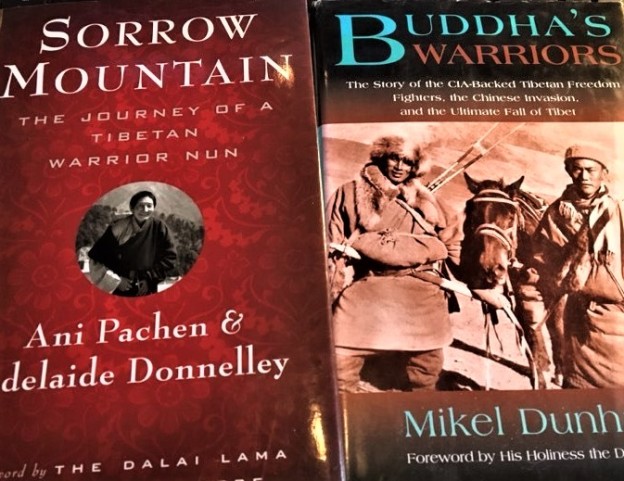
Two books I have read recently that may appeal to some of you who are interested in the broader topic of holy war are Sorrow Mountain: The Journey of a Tibetan Warrior Nun and Buddha’s Warriors: The Story of the CIA Backed Tibetan Freedom Fighters, the Chinese Invasion, and the Ultimate Fall of Tibet (both pictured above). Continue reading

Guest Essay: A Colony by Any Other Name: The Latin States of Syria-Palestine

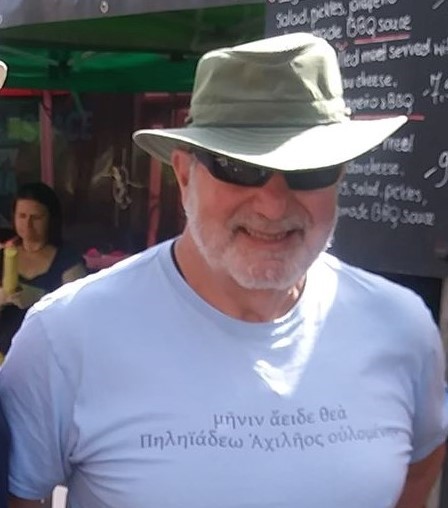
Above Image: Historian Alfred J. Andrea walking along the famous markets at Portobello Road in London.

The following essay is the text, slightly revised, of a brief talk given by historian Alfred J. Andrea at the International Medieval Congress at Leeds, U.K., on July 3rd, 2019. Dr. Andrea, Professor Emeritus of the University of Vermont and former President of the World History Association, gave these introductory comments as part of a panel considering crusade myths that also included historians Natasha R. Hodgson, Alan V. Murray, and Aphrodite Papayianni. Here Dr. Andrea provides a nuanced reassessment of the issues of colonialism and crusading. In keeping with current scholarly views of the crusades, Dr. Andrea agrees that comparisons of the crusader states with modern 19th and 20th century western colonial models are wrong. Yet, as a world historian, Dr. Andrea also points out that historically there have been many forms of colonialization worldwide.

———————————-

A Colony by Any Other Name: The Latin States of Syria-Palestine

Guest Essay by Alfred J. Andrea

Joshua Prawer famously argued in his 1972 study of the Latin Kingdom of Jerusalem that the economies, societies, and institutions of the states of the Latin East, and predominantly those of the Latin Kingdom of Jerusalem, are understandable only if one realizes that they were colonies of Western Europe and especially so of Franco-Europe.[1] He further maintained that it was only with the crusades that colonialism became a major factor in world history, and in that sense  “the Crusader kingdom” was the first European colonial society.

Leaving aside for the moment Prawer’s argument that the states of the Latin East were Western Europe’s initial venture into global colonialism, the fact is that the states of the Latin East are viewed in the popular imagination as examples of early Western colonialism. In the words of Karen Armstrong, whose best-selling books have misguided many who seek to understand the crusades, “These soldiers of Christ established European colonies in the Middle East and began to dream of world domination.”[2]

In reaction to similar popular, often overstated and erroneously envisioned notions of crusader colonialism—a colonialism misrepresented in numerous media, including such films as The Kingdom of Heaven (2005)[3]—a significant number of eminent scholars have derided the very idea of a colonial Latin East as unadulterated myth.[4]  Thomas Madden, for example, referring to the four states that comprised the Latin East, argues that: Continue reading