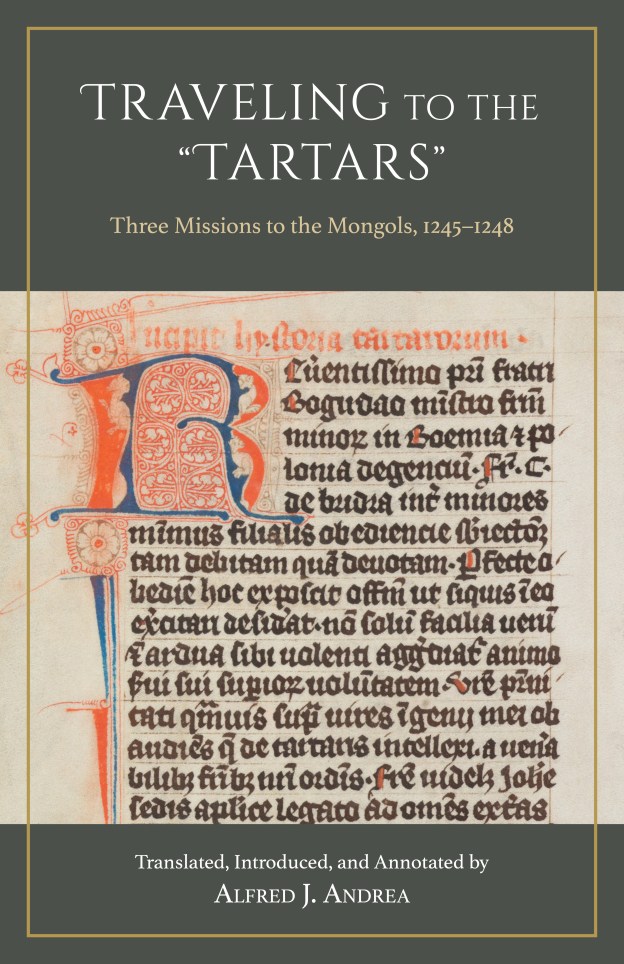
Over the next several posts, I will be presenting a sustained, multi‑part (and at times) longform interview with my dear friend, medieval historian Dr. Alfred J. Andrea, on the occasion of his forthcoming volume, Traveling to the “Tartars”: Three Missions to the Mongols, 1245–1248 (Indianapolis: Hackett Publishing Company, 2026). This project brings together six major textual witnesses to the earliest papal embassies sent to the Mongol Empire and offers them in new, carefully annotated translations. In the series that follows, Dr. Andrea addresses a range of questions concerning the origins and aims of the book, the historical significance of these thirteenth‑century encounters, the ways in which these friars’ reports have shaped modern understandings of early Mongol–European contact, and the methodological challenges posed by reading medieval ethnographic and diplomatic texts through contemporary lenses. He also reflects on the surprising modern resonances of cross‑cultural diplomacy, misinformation, and long‑distance communication, issues that confronted these envoys in the 1240s and continue to confront us today.
Without delay, let’s get to question 1.
This project brings together six major sources on the earliest papal missions to the Mongols and presents them in new, carefully annotated translations. For readers who may not be familiar with these missions or the significance of these documents, could you begin by explaining what the book is about, how the project came together, and what drew you to undertake it in the first place?
This question would take me many hours and several hundred pages to answer fully, but I will try to limit myself to far fewer. In fact, because I am a nice guy who does not want to exhaust anyone, let’s break this into two discrete replies.
Let me first give you a bit of mid-thirteenth-century background and briefly tell you who went on the missions and where they went. Well, that is briefly as far as I am concerned. Ask my former students, my colleagues, and my long-suffering wife how I can go on endlessly whenever I discuss anything relating to medieval history.
Then, after weary readers have taken a break (and some might be tempted to make it a very long break), they can read a bit about the documents contained within this book, why I chose them, and why I embarked on the project (apart from sheer lunacy). And finally! (mercifully), I want to discuss in ever so brief detail a competing book.
OK. Let me begin.
Background
As every reader knows, early in the thirteenth century, Mongols under the leadership of Chinggis Khan (aka Genghis Khan) burst out of their homeland and began a series of raids and conquests that resulted in their creation of the largest contiguous land empire in history. As early as 1238, the papal court received a troubling report from a Hungarian Dominican named Julian regarding the “Tartars,” who planned to invade his homeland (“Tartar” became the common Western term for the Mongols, who totally rejected this insulting xenonym). And shortly thereafter, in 1241-1242, the Mongols swept into the Christian lands of Rus’ (today western Russia, Ukraine, and Belarus), Poland, and Hungary, and even momentarily reached the Adriatic. Although they retreated to the Lower Volga in 1242, after leaving behind a wide swath of destruction and death, there was good reason to fear they would return and press on to Rome, Paris, and beyond.
On 16 June 1241, Pope Gregory IX authorized a crusade against these fearsome invaders from the East, but it fizzled out. The pope died shortly thereafter, and a two-year interregnum followed due to deep divisions within the College of Cardinals. Finally, when Innocent IV assumed the papal throne on 25 June 1243, he began to devise ways in which to counter effectively this menace from the far reaches of Asia. As part of his overall strategy, in March 1245, the pope dispatched three missions of mendicant friars with two letters for “the Tartar king” and another letter for various Eastern Christian secular and ecclesiastical leaders. Taken as a whole, the three letters strongly suggest the dual purpose of these missions: To find out who these Tartars were and what their plans were regarding the West and to form an Eastern alliance against the Mongols under papal leadership.
Seven Preaching Friars, Three Friars Minor, and Three Missions to the Mongols
As noted, three missions headed east. Originally, the pope had envisioned sending out four missions, but settled on three, which involved the labors, adventures, and misadventures of ten mendicant friars: seven Preaching Friars (aka Dominicans) and three Friars Minor (aka Franciscans). Reducing the embassies by one appears to have been a strategic decision based on information provided the pope and his court by Peter, bishop of Belgorod and vicar of the metropolitanate of Kyiv, who appeared at the papal court-in-exile at Lyon, France in 1244/45. Bishop Peter informed the pope and his advisors that three Mongol armies were in the East. One was aimed against Iran and Iraq; a second concentrated on the Seljuk Sultanate of Rum in Anatolia (present-day Asian Turkey); the third was focused on Rus,’ Poland, and Hungary. Three armies, three missions (not unlike the Texas legend: One riot, one Ranger).
Friar Andrew of Longjumeau’s Mission
The Dominican friar Andrew of Longjumeau departed Lyon in early Spring 1245 and traveled to Acre in the Latin Kingdom of Jerusalem, which he reached in early to mid-summer. Before proceeding farther east in search of Mongols, he and an unnamed companion, who probably joined him in Acre, visited a substantial number of Eastern Christian and Muslim leaders throughout much of the Levant and northern Egypt. Their visits to Muslim lords proved unrewarding and attempts to bring Eastern Christian church leaders into the embrace of the Roman Church initially appeared successful but ultimately failed. From there the two friars traveled to Tabriz, Iran, where they encountered a Mongol army and passed on the pope’s letters. There they also met with Simeon Rabbanata (Master Father, or Abbot, Simeon), with whom they spent twenty days. Earlier the Great Khan Ögödei had sent Simeon into western Central Asia as supervisor and protector of its portion of the Church of the East (the so-called and totally misnamed Nestorian Church). To put it succinctly, the friars and the monk enjoyed an amicable relationship. So much so, in fact, Andrew characterized Simeon as “a man of religion and a Catholic in his conduct, manner of life, and faith” and “a person of such righteousness and abstinence that he is most certainly and truly regarded as saintly.”
Abbot Simeon appointed two envoys who later traveled to Lyon with Andrew, bearing the gift of an ivory walking stick and a little book from China, a letter for the pope, letters for Emperor Frederick II and King Louis IX of France, and a declaration of faith offered by the Church of the East’s archbishop of Nisibis (today Nusaybin, Turkey), to which five other prelates and the rabbanata added their signatures of approval. The archbishop’s confession of faith was a model of ecclesiastical diplomacy and skirted any issue that could devolve into a doctrinal squabble.
Additionally, Andrew met with the two highest-ranking leaders of the Syriac Orthodox Church (the so-called Jacobite Church) and received three letters from them affirming papal primacy but without compromising the core doctrines and independence of their Church. In brief, these “Jacobite” churchmen perceived the need to seek the assistance of the crusading West while still maintaining the traditions and freedoms of their Church. On the surface, therefore, Friar Andrew’s diplomatic overtures to several Eastern Christian prelates produced results pleasing to Innocent, but with the Latin West unable to offer meaningful military help, these confessions of faith and declarations of obedience went nowhere and did not result in any ecclesiastical union whatsoever. Friar Andrew returned to Lyon around mid-to-late July 1247, delivered the letters and gifts, and rendered a report.
Friar Ascelin of Lombardy’s Mission
A second Dominican, Friar Ascelin of Lombardy, probably departed Lyon in the company of Friar Andrew but parted company sometime after arrival at Acre. Presumably while in the Latin Kingdom, Ascelin picked up three other friars, Albert, Alexander, and Simon of Saint-Quentin. Like Andrew and his companion, the four friars spent quite a bit of time visiting Eastern Christian church leaders and Muslim lords, but unlike the other Dominican delegation, their mission did not enjoy even apparent success. Traveling farther east, in Tiflis, Georgia, they picked up another Preaching Friar, Friar Gerard of Cremona, who would serve as their interpreter. Finally, the five men reached Sisian in Armenia on 24 May 1247, where Baiju, one of the most powerful and successful Mongol leaders, had his summer encampment. There, for reasons that should be apparent to anyone reading the translated account of this mission’s misadventures, the friars ran afoul of Baiju and were threatened with ghastly deaths. Through some good fortune (and the intervention of one of Baiju’s wives), they escaped execution, delivered the letters, and finally departed, accompanied by two envoys, a Turk and an Eastern Christian, whom Baiju dispatched to the pope.
On their way back, they encountered a mortally ill Simeon Rabbanata in Tabriz. In contrast to Friar Andrew’s meeting with the monk, this visit with Simeon was not amicable. Simon of Saint-Quentin, who later penned an extensive account of the mission, described the abbot as a diviner, usurer, heretic, and sham holy man, “who was hostile to the Catholic and Orthodox faith.” Consequently, the friar concluded, Simeon “died as he had lived” and “descended into Hell.”
Sometime in the late spring or early summer of 1248, Ascelin bid farewell to at least two of the other three Dominicans and boarded a ship in Acre, accompanied by Baiju’s two envoys and possibly Simon of Saint-Quentin. The three or four men reached Lyon in autumn, probably in November. Of the three missions, Ascelin’s was far and away the longest in time, having lasted three years and seven months, but except for the information it brought back to the West, it was a failure.
Friar John of Plano Carpini’s Mission
John of Plano Carpini, a first-generation Franciscan who was at least in his mid-50s in 1245 and was notoriously corpulent, proved to be the hardiest of all, traveling all the way from Lyon to central Mongolia and back by way of Poland and Rus.’ In brief, his was the farthest-ranging and most successful of the three missions to the Mongols. And it justifiably became the most celebrated.
Accompanied by Friar Ceslaus the Bohemian (aka Stephen the Bohemian), Friar John departed the papal court on 16 April 1245 (if we accept the date supplied by Benedict the Pole [see below]), beginning a journey that covered more than eighteen thousand kilometers (eleven thousand miles) and lasted two years and seven months. In Silesian Poland, John gained a second companion, Friar Benedict the Pole, who proved to be an able and invaluable translator and an equally hardy partner in this adventure.
After leaving Lyon in mid-April, Friar John traveled across northern Europe to Kyiv, where he made initial contact with the Mongols sometime in mid-or-late January 1246, a journey that took at least nine full months. Strategically planned visits with a variety of central and eastern European crowned heads, during which the friars endeavored to rally them to a common defense of Christendom (and in the case of the Rus’ to bring their Church under papal authority), were the primary reason for this slow pace and likely followed a plan laid out by the pope. Shortly thereafter, John and Benedict left behind an ill Ceslaus in central Ukraine, where he recuperated, and the two friars and their small retinue of attendants proceeded east with a Mongol guide. Eventually, after a treacherous journey in the dead of winter across frozen steppe lands, the two friars arrived at the ordo, or camp, of Batu Khan, Chinggis Khan’s grandson. Although weak (but not frail) and fully fatigued, four days later, on Easter Sunday, 8 April 1246, they were sent off with an escort to Mongolia to view the enthronement of the next Great Khan. Denied a decent diet, the duo departed–debilitated, despondent, and dispirited but doubtlessly determined to deliver the dispatches.
Pushed to their limit by their Mongol guides, John and Benedict covered almost forty-eight hundred kilometers (three thousand miles) in ninety-five days, a pace of roughly forty-eight km (thirty miles) per day, and arrived at the ordo of Güyük Khan, another grandson of Chinggis Khan, on 22 July. There they resided for four months, witnessed Güyük’s enthronement as Khagan, or Great Khan, and interviewed a sizable number of enslaved Europeans, from whom these papal spies gained a considerable amount of information.
Following several visits to the Great Khan and visits also with his mother, the friars began their homeward trek in mid-November. It was brutal. As Friar John later recollected, at night, “we often lay down in the snow, except when we were able to clear a place for ourselves with our feet.” Along the way, they picked up Friar Ceslaus and others of their retinue whom they had to leave behind, and reached Kyiv on 9 June 1247, where they parted from their Mongol escort. Still on duty, they then visited the Rus’ princes Danylo and Vasilko Romanovych, who affirmed the Rus’ Church’s willingness to accept papal primacy in return for substantial aid against the Mongol threat, and dispatched in the friars’ company letter-bearing envoys to the pope. This proposed union of Churches went nowhere due to the West’s inability to offer meaningful military support.
The three friars finally reached Lyon on 18 November. We can only guess at their level of travel-weariness.
Reporting Their Experiences and Discoveries
Friar Andrew’s Report
Andrew of Longjumeau’s report of his adventures in the east is now lost except for a brief digest preserved by the English monastic chronicler Matthew Paris. Given that only one manuscript of it survives, and it is the autograph (the manuscript in Matthew’s hand), we can assume it never circulated beyond the confines of Matthew’s Saint Alban’s Abbey.
Simon of Saint-Quentin’s Account of Friar Ascelin’s Mission to Armenia
Even failures have their worth, and one of the most significant consequences of Ascelin’s mission was the Historia Tartarorum (translated as A Description of the Tartars), Simon of Saint-Quentin’s lengthy account of what he had seen, heard, and experienced during the little more than two years he spent in Ascelin’s company. In addition to providing insightful information regarding the Mongols, Simon’s Historia contains a wealth of detail regarding the Georgian and Armenian forms of Christianity and, even more so, the political and military fortunes of the Sultanate of Rum, which dominated central and eastern Anatolia until its defeat by the Mongols in 1243.
The work is lost in its original form, but the Dominican encyclopedist Vincent of Beauvais incorporated major portions of it into the last three books of his Speculum historiale (The Mirror of History), a vastly popular (and vast) history of humanity from Creation to 1254. It was in that form that the Historia Tartarorum reached Western Europe’s literate public that was still small but growing in numbers and influential beyond its numbers.
Three Accounts of Friar John’s Mission to Mongolia
Upon his return to the West, John of Plano Carpini noted: “We had a mandate from the Supreme Pontiff to look all about and examine everything carefully. This we zealously did, both we and likewise Brother Benedict the Pole.” He did not exaggerate. Both men proved to be exceedingly flexible and perceptive travelers in an environment that was often quite alien to them and, even more significant, both were more-than-able reporters of what they had seen and examined. The result was the creation of three extraordinarily valuable accounts of their experiences and discoveries
The most important and well-known of the three is the Historia Mongalorum quos nos Tartaros appellamus (translated as A Description of the Mongols Whom We Call Tartars, abbreviated as HM). The HM comes down to us in two editions: an eight-chapter version that Friar John, with Friar Benedict’s assistance, composed well before reaching Lyon and a revision in nine chapters. The first version is a detailed intelligence report on Mongolia and its people, an equally detailed operational plan that offered an overall strategy for countering an expected Mongol invasion, and a long list of recommended battle tactics designed to enable the West’s warriors to defeat a ruthless but not invincible enemy. The second edition contains a few minor revisions of the eight chapters and adds a lengthy ninth chapter detailing the friars’ journey to Mongolia and back. As such, it is a rip-roaring tale of courage and determination in the face of adversity but narrated in a manner that is not self-aggrandizing. Both versions of the HM were widely disseminated and copied, making it something of a sensation among Latin Europe’s intelligentsia. In addition to twenty extant manuscript copies of one or the other edition, we possess extracts from it preserved in the pages of Vincent of Beauvais’s Speculum historiale serving as supplements to Simon of Saint-Quentin’s account.
In Chapter IX of the second edition, Friar John informed readers that: “People through whose lands we transited in Poland, Bohemia, Germany, and in Liège and Champagne gladly took possession of the account written above and consequently copied it before it was finished and even when it was in quite abbreviated form, inasmuch as we had not had a quiet time in which we could complete it fully.”
One of the people who eagerly “took possession” of the first edition was an otherwise unknown Polish Franciscan, self-identified simply as C. de Bridra (aka C. de Bridia). Friar C. probably encountered the returning envoys in Polish Silesia in mid-July 1247, where he interrogated his fellow Pole, Friar Benedict, and had an opportunity to read and copy, at least in part, Friar John’s report-in-progress. The result was the Hystoria Tartarorum (translated as A Description of the Tartars but aka The Tartar Relation). Although based in good part upon the HM, its significant differences in organization and style and, most important, its inclusion of a decent amount of additional information and detail show it to be an independent and important account.
On 3 October 1247, while passing through Cologne on the way to Lyon, Benedict told his story to an anonymous high-ranking churchman, and the conversation resulted in the Relatio Fratris Benedicti Poloni (translated as The Narrative of Friar Benedict the Pole). Despite its brevity, it contains vital information not found in the HM or Friar C. de Bridra’s account, including a copy of the letter of Güyük Khan to the pope.
The Documents Within This Book
In addition to the five documents mentioned above, each of which fully deserves inclusion in Traveling to the “Tartars,”I added Salimbene de Adam’s remembrances of his encounters with John of Plano-Carpini following the friar’s triumphal return to Lyon, thereby filling out our picture of this loyal agent of the pope. Also, because much of John of Plano Carpini’s description of the Mongols, and to a lesser extent that of Simon of Saint-Quentin, addressed, expanded upon, and even corrected points made by Bishop Peter of Belgorod at the papal court, I added as an appendix two somewhat different versions of this Rus’ churchman’s testimony, which is known as the Tractatus de ortu Tartarorum (translated as A Treatise on the Rise of the Tartars).
I was sorely tempted to add many other documents, including several papal letters, but ever mindful of the book’s length and cost (and my extensive and often verbose footnotes had already added considerably to its length), I fought off the temptation. And I do not regret that decision inasmuch as I envision Traveling to the “Tartars” as a niche publication intended primarily for classroom use, as well as the edification of general readers.
But Whatever Impelled Me to Undertake the Project?
For many years I taught advanced-level courses and seminars on the mendicant friars’ activities in Mongol-dominated Central and East Asia in the period from roughly the 1230s to the 1350s. One of our core texts was Christopher Dawson’s pioneering Mission to Asia, which includes English translations of a number of critical sources relevant to the thirteenth- and early fourteenth-century travels of various Franciscan friars to Central Asia and China. Prominent among the documents is Friar John’s report of his adventures and discoveries. The book served the students well, but by 2020, it suffered from age. Originally published as The MongolMission in1955, it did not reflect the subsequent wealth of studies on the Mongols and the clerics who traveled to and worked amid them. Moreover, the Latin text of Friar John’s report used by Dawson’s translator, although excellent, has been superseded by a later, far better critical edition. Additionally, for all its richness, Dawson’s compendium of sources totally neglects the Dominican missions. Finally, the texts offered (and they include some documents not to be found in Traveling to the “Tartars”)are exceedingly light on explanatory notes. Without such notes, readers miss quite a bit. In fact, it is a constant refrain of mine that translators of critical sources must provide reasonably full context in their introductions and, additionally, must explain all obscure references in notes (preferably footnotes not damnable endnotes that most readers skip). Without such aids, readers can, and usually will, become lost through no fault of their own.
In addition to the excellent critical edition of the HM that was now available, a second manuscript of Friar C. de Bridra’s Hystoria Tartarorum (The Tartar Relation) had come to light, and a critical edition of the text based on the two now-known manuscripts appeared in 2019. Finally, the eminent crusade historian Jean Richard had extracted what he could of Simon of Saint-Quentin’s Hystoria Tartarorum from the pages of Vincent of Beauvais’s Speculum historiale and published it with helpful explanatory notes. So, it seemed to me that the time was right to present the texts mentioned above in new translations—translations that are in twenty-first-century American English and fairly well introduced and annotated.
And a “Competitor”
I will end this overlong monologue by noting a “competing” book that appeared this year, only a few months before the appearance of Traveling to the “Tartars” which, as of today, 21 June 2026, is due out soon if the planets align properly. It is Early Western Missions to the Mongols (1245-1248): The Opening of Diplomatic Contacts with a New World Power, edited by Peter Jackson.
Despite my lightly tossing off the term “‘competing’ book,” I do not see it as competition in any way whatsoever. It is a work of first-class scholarship by a master historian, who has established himself as the preeminent scholar in the field of Latin Europe’s contacts with the Mongols.
In his book, Jackson not only offers richly annotated translations of each of the sources that appear in my little book, but he also translates and annotates brilliantly thirteen other key sources. As such, it is a fitting supplement to his equally important monograph The Mongols and the West, 1221-1410, 2nd ed. (2018), from which I and so many others have profited greatly.
Aimed at advanced students and scholars, the hard-bound version of the book is offered by the publisher at a hefty $200 (but with a reduced introductory price of $160). This price is the norm for works such as this and is not excessive considering its limited potential purchasers. My own Contemporary Sources for the Fourth Crusade currently sells for $294. As already noted, my more modest effort, which (to repeat) is aimed primarily for use in the classroom by undergraduate students and those members of the general reading public who are interested in this topic, was composed with length and cost in mind, and will sell for about $20 in paperback. In summary, I see Jackson’s book as nicely complementing mine and vice versa (I hope).
Ok. That is my story. I hope this little book serves its intended readership well.
Dr. Andrea will be addressing additional questions in follow-up posts. These questions will collectively explore, among other things, how the earliest papal missions to the Mongols were understood, recorded, interpreted, and remembered, examining their historical significance, the friars’ roles as observers and intelligence gatherers, the diversity of their perspectives, the problem of medieval Orientalism, and the enduring relevance of thirteenth‑century cross‑cultural diplomacy for both scholars and modern readers.
 Andrew Holt, Ph.D.