Studying Medieval History and Fighting ISIS?

Republican presidential candidate Carly Fiorina recently announced that her study of medieval history as an undergraduate at Stanford University in the mid-1970s would aid her as a future commander-in-chief in the war against ISIS.

http://www.thedailybeast.com/cheats/2015/10/05/fiorina-my-degree-will-help-fight-isis.html?source=TDB&via=FB_Page

She reasoned that ISIS is essentially medieval, seeking to drag the people and societies it controls back to the Middle Ages before listing a number of atrocities carried out by the group including burning prisoners to death, crucifixions, and beheadings. Because she associated these actions exclusively with the Middle Ages, she argued her education in medieval history would serve her well in dealing with these problems.

Is she right?

Medieval historians, like myself, tend to cringe when they hear modern commentators refer to something particularly brutal as uniquely medieval, as if brutality defined the Middle Ages in contrast to an enlightened and more gentle modern world. The reality is that medieval barbarism, as bad as it could be at times, often pales in comparison to the horrors of the technologically advanced 20th century, which include over sixty million people killed in World War II, the first use of Atomic Weapons, tens of millions killed under communist regimes, and the Holocaust.

Yet, as recently pointed out in a much discussed piece by Graeme Wood for The Atlantic, to dismiss any connection between ISIS and medieval history would be wrong. The self-declared “Caliphate” created by ISIS claims its legitimacy, and authority, is demonstrated in its adherence to the earliest Islamic principles as reflected in the life and examples of the Prophet Muhammad and its strict adherence to the Qur’an. Muhammad’s time as a religious leader and the emergence of the Qur’an came during the seventh century, which is about as medieval as one can get.

The leaders of ISIS often point to medieval historical examples and religious texts to cite precedents that they argue justify their own extreme actions. In light of this, Fiorina is correct in the sense that a western leader well educated on early/medieval Islamic history could have a better understanding of how ISIS and their supporters interpret their actions, motivate their followers, and justify their actions.

The problem is that I have no idea how much knowledge of medieval history Fiorina picked up as an undergraduate at Stanford and has retained since then. I doubt that, as a busy CEO and businesswoman, she has had much time or interest in keeping up with medieval scholarship over the past few decades. Yet her broader point, that knowledge of the Middle Ages can be helpful for modern leaders facing some of our current challenges, is valid.

One well versed in medieval history is presumably more aware of historical understandings of the life and example of the prophet Muhammad (which still influences the actions of many Muslims today), the emergence and background of medieval religious texts like the Qur’an, the basis for the Sunni-Shia split (contributing to extensive conflict within the Muslim world even today), the historical treatment of non-Muslims in Muslim ruled lands (a pressing issue at the moment as we have recently seen step declines in Middle Eastern Christianity), the causes and consequences of the crusades (whose interpretation remains a hot button issue among many today), etc…

Fiorina’s suggestion that her study of medieval history is valuable for understanding events in the present has been mocked, but one could certainly do worse than to have a solid understanding of the medieval past as a base from which they consider some of the issues we face in our presumably “clash of civilizations” modern world.

*Updated on 10/8. ———————————–

*A 350 word version of this essay was published as a “Lead Letter” in the Florida Times Union on 10/9/2015. See http://jacksonville.com/opinion/letters-readers/2015-10-09/story/lead-letter-fiorina-has-point-suggesting-history-background

——————

Below are some additional thoughts of mine on a Facebook post (10/7/2015) on a thread by Paul Halsall linking to a recent essay by David Perry for The Guardian (Available at: http://www.theguardian.com/commentisfree/2015/oct/06/carly-fiorina-medieval-history-degree-fight-isis?CMP=share_btn_fb )

My comments follow:—————

I’m not entirely sure of one of David’s points. While I respect David as a thinker and writer, he seems to be hedging his bets in this piece a bit.

In one place, at least, he seems to be mocking Fiorina’s suggestion that a degree in medieval history is useful for a political leader dealing with modern problems involving the Islamic world. He writes:

“She really does seem to be claiming that her undergraduate degree [in medieval history] will enable her to make sound foreign policy decisions…”

But elsewhere he writes:

“the Middle Ages do in fact shape contemporary events all the time…”

And…

“I believe that we need to study the past in order to respond to the present…”

Based on these last two comments David clearly see’s value in studying medieval history to “respond to the present.” So in that sense, at least, he agrees with Fiorina’s larger point, even if he does not like doing so.

Let me get into the weeds a little bit here. As you all know, ISIS bases its ideology on how it interprets medieval events and medieval texts. Particularly the life and example of the Prophet Muhammad in the seventh century (which they cite all the time to justify their actions- e.g. “Muhammad burned apostates according to the Hadith so it’s okay for ISIS to do it.”) and the Qur’an and other texts that emerged around this time. Understanding that, to some degree, is unquestionably a huge plus for any political leader. In fact, in an ideal world, I would wish all western generals and politicians who involve themselves in Middle Eastern affairs had a solid grounding in a number of medieval topics (e.g. the rise of Islam, the evolution of Islamic beliefs and texts, etc…). Even if ISIS is somehow interpreting those medieval events and texts incorrectly, then one needs an education in medieval history to know the difference and be able to argue the point.

Also, there are so many other ways an education in medieval history can help one better understand events in the present. One of the reasons I have been called on so much by local media to comments on ISIS and events in the Middle East is because such media often has very basic questions on topics like the origins of Shia-Sunni animosity, which is rooted in the Middle Ages, or questions about crusading rhetoric often used on both sides in modern clashes between Islamists and westerners, the historic treatment of non-Muslims under Muslim rule, or many other topics. Nobody else [or at least very few] at my college really has the background in those areas (e.g. early Islam, the crusades, etc…) that I as a medieval historian have. That became a base from which I have come to analyze events in the M.E. over the past 15 months or so, doing no less than 32 interviews with local media. So I certainly know from personal experience that having a background in medieval history can help one better understand (than many people without such an education) at least some of the complexities of current events in a way that engineering or accounting majors, for example, will not understand. I admit that knowledge of medieval history alone was not enough to provide coherent commentary on current events, but it was undoubtedly a solid base from which to engage in additional studies over the past 15 months.

So on this very basic point, that a background in medieval history is useful for a leader dealing with modern relations between the west and the Islamic world, Fiorina is obviously right.

Now, whether or not Fiorina actually remembers anything about the Middle Ages from her studies at Stanford back in the 70s, or her study of the Middle Ages involved any significant focus on Islam or related topics, is entirely another topic and fair game. I doubt as a business woman and CEO she bothered to keep up with recent medieval scholarship over the past 40 years since she graduated and I have no doubt that like a good politician she is touting her degree in the most opportunist of ways. But nevertheless I don’t like seeing some commentators (not referring to David here) dismiss the value of medieval history with regard to understanding current events. Diss Fiorina all you want and question her motives, but not the value of studying the medieval past for a greater grasp of events in the present. On that point she is right, even if she is only saying it to score political points rather than maintaining any real devotion to understanding the Middle Ages.


Continue reading

Crusading Against Poor History: An Interview with Dr. Paul Crawford

In 1940, the eminent crusade historian John L. La Monte complained of how, with the possible exception of Renaissance Florence, “no field” of historical research “has been the subject of so much worthless historical trash” as the medieval crusades. Over the last fifteen years, since I first began to study the medieval crusading movement as an undergraduate, I have increasingly come to appreciate the dim view of La Monte, as many crusade historians have continued to have very similar concerns about much of what has been published on the subject in the seventy-five years since La Monte first made his claim.

Consequently, when historian Alfred J. Andrea and I began to consider the idea of a book on modern popular myths of the medieval crusades, we were not surprised by the widespread interest we found among crusade historians in the project. Indeed, since 2008, when Al and I first discussed the topic at a crusade history conference in St. Louis, a number of crusade historians have had serious questions about the project, expressed curiosity over which of the many possible myths we might address, and often also expressed an interest in contributing to the project. Thus, it is not surprising that our final effort, Seven Myths of the Crusades, to be published in September 2015 by Hackett Publishing, involves the collective efforts of ten professional medieval historians who all teach, research, and write about the crusades. One of those historians is the widely respected and well-known Dr. Paul Crawford of California University of Pennsylvania.

Continue reading

The Most Dangerous Man in Medieval Studies: An Interview with Peter Konieczny

Peter Konieczny (pronounced Co-nietch-knee) has been a regular presence at the International Medieval Congress at Kalamazoo (“the Zoo”) for nearly two decades. He first began attending the congress in 1996, when he was an undergraduate studying history and politics at the University of Toronto, and since then has only missed two of the annual conferences. While Peter is known for his quiet and unassuming demeanor at Kalamazoo, very approachable and friendly, this masks the profound impact and influence he has on the field of medieval studies. Indeed, as the founder and co-owner of the popular website Medievalists.net, Peter has become a force in how medieval  scholarship is made accessible or communicated to the public via the internet and social media.

PeterMedNet

I was recently reminded of Peter’s influence when I forwarded him a link to a short interview I had with the great medieval historian Dr. Alfred J. Andrea (a friend and mentor). I published the interview on my blog, which on a typical day might receive 50 to 70 “views.” When Peter agreed to post the interview on his Facebook page for medievalist.net, I thanked him, but did not immediately think much of it. About 20 or 25 minutes later, however, my stats on my little blog had gone through the roof. Those who follow Peter’s page, people with a significant interest in all things medieval, had read the interview and then shared it with others. As a result, the interview was launched into cyber space and Al was getting a lot of well-deserved press for his excellent career as a medieval historian. In response to all of this, due to his ability to influence what people interested in the Middle Ages read, I joked with Peter that he was a “dangerous man.”

As it turns out, those initial impressions were true. Continue reading

The Iran Deal and ISIS?

Regardless of the debate over the broader merits of the plan, when I first heard about the controversial recent deal by the U.S. and other countries with Iran, lifting sanctions on Iran in exchange for a suspension of their nuclear efforts, I immediately thought of how ISIS (e.g. “Islamic State”) might factor into this.

Continue reading

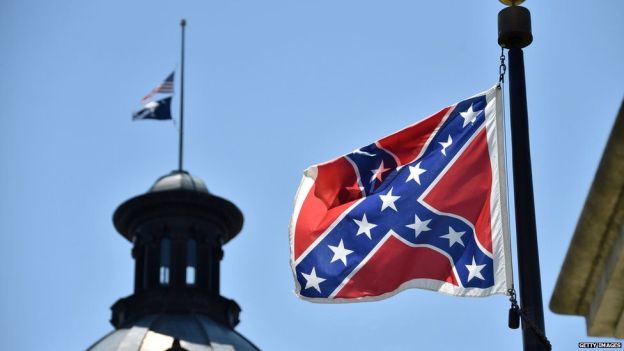
A Medieval Historian (from the South) Weighs in on the Recent Confederate Flag Controversy

A reporter for the Florida State College at Jacksonville student newspaper, The Campus Voice, recently requested an interview for a story she was writing on the recent controversies over the display of the Confederate battle flag above various government grounds or buildings in southern states. After some hesitation, I granted the request, and as is common with these types of stories, only a small amount of the information I provided could be used in the story (which was no fault of the reporter, who did a fine job with the limited space she was provided), and so I figured I would provide some additional commentary here.

First, I should mention that I am not a historian of pre-Civil War southern U.S. history. Instead, I am a historian of medieval Europe, so this is not the primary focus of my research or publications. Nevertheless, having grown up in the south, moving there from Pittsburgh when I was a kid, I have been exposed to various narratives of southern history most of my life. I also took considerable coursework on the topic as an undergraduate and graduate student and I later taught several lower level courses on American history as a graduate student and professor. In light of the interview, there are a couple of points that I want to be very clear about.

First, I do not think the Confederate battle flag should be flown above any U.S. government buildings or properties. Because this view will undoubtedly be controversial with a number of my friends or acquaintances, many of whom I care very deeply about, let me offer my reasons here.

Continue reading

The Future of Medieval History: An Interview with Dr. Alfred J. Andrea

“Retired” scholar Alfred J. Andrea is easily one of the most active and dynamic historians I know. As an accomplished author, editor, and Professor Emeritus of Medieval History at the University of Vermont, you might think he would take it easy in his retirement. Yet those who know Al know better. The 73-year-old former U.S. Marine still looks the part, Continue reading

Learning to Live with ISIS? -The One-Year Anniversary of the “Islamic State.”

It was around this time last year that the “Islamic State of Iraq and Syria,” which currently refers to itself as the “Islamic State,” emerged out of the ongoing Syrian conflict to invade and extend its rule from Syria into northern Iraq. Since then, ISIS has carried out a high number of atrocities against anyone that did not adhere to their views of Islamic religious orthodoxy or morality. Their often-gruesome actions and appalling ideological views have brought an extraordinary amount of media attention. Indeed, in the last twelve months, I alone have been called on to give no less than 27 television or radio interviews on topics related to ISIS for local media in the Jacksonville area. Thus, like many other Americans, I have watched the evolution of the organization very carefully over the past year. Now, a year after ISIS first emerged on the scene, I am have far greater concerns about the group’s staying power and potential for growth.

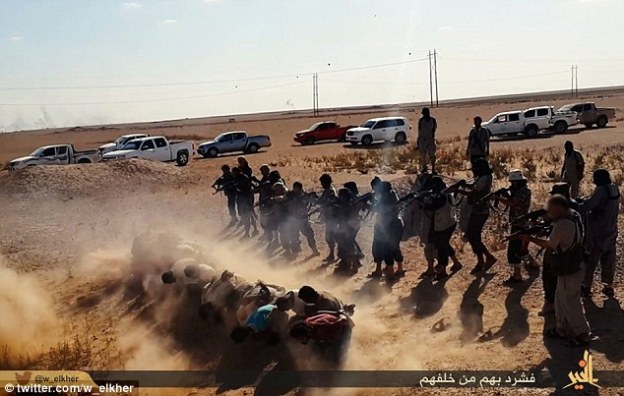
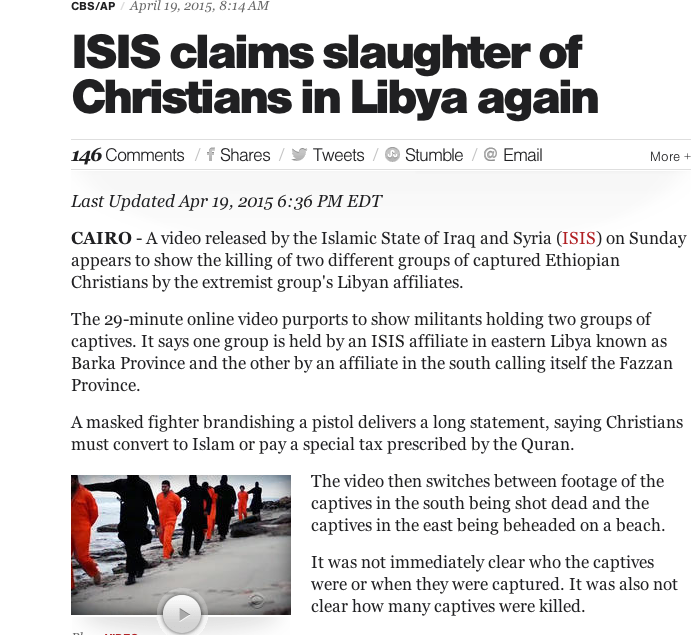
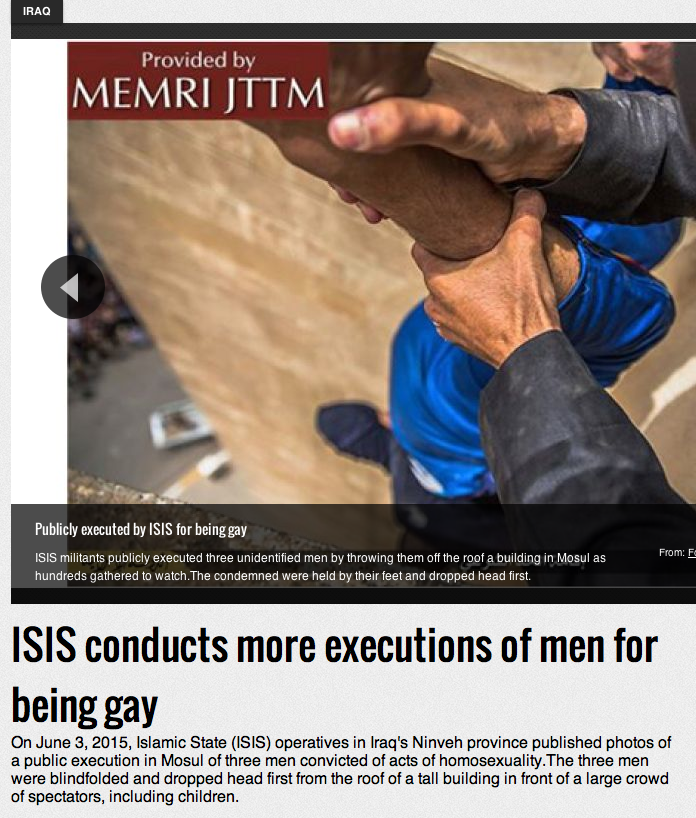
As has been well documented on video and by numerous eyewitness accounts, their catalogue of abuses include the sexual enslavement of thousands of very young Yazidi girls, the public beheading and humiliation of Christians, and the execution of homosexuals by throwing them from the roofs of tall buildings. Yet, in terms of total numbers, it is their fellow Muslims, primarily Shia, who have suffered the most under their rule.

Screen shot 2015-06-19 at 11.55.16 PMScreen shot 2015-06-19 at 11.57.27 PMScreen shot 2015-06-19 at 11.59.12 PMScreen shot 2015-06-20 at 12.00.58 AM Continue reading

“Thou shalt not kill” vs. “Thou shalt not murder”

When I lecture on the First Crusade in my courses at Florida State College at Jacksonville, I occasionally get a question from one of my students along the lines of “How could Christians do this?”

They ask because, as modern Christians with a post-Enlightenment understanding of their faith, they find the idea of God- or Jesus more specifically- supporting warfare to be troubling. Such students tend to associate New Testament Christianity with peace as Jesus himself famously called on others to turn the other cheek when confronted with violence. Often, in such cases, students will cite the biblical commandment “Thou shalt not kill” (Exodus 20:13) as a proof-text supporting their assumptions that medieval Christians who participated in the crusades simply did not understand the Bible.

I find I often have to restrain myself a bit when I respond. Not because I am upset with the student, of course, but because I feel tempted to cover too much in my response. There are a number of assumptions here that are either demonstrably false or (at the least) highly debatable, but among the most significant, perhaps, is the idea that Exodus 20:13 represents a biblical injunction against “killing.” There are two major problems with this assumption. Continue reading

Guest Essay: The Four-Minute Expert by Dr. David Schwam-Baird

UNF Political Science Professor Dr. David Schwam-Baird is a regular go to source for local media in the Jacksonville area on all things political. He has given numerous television interviews on topics ranging from domestic political affairs to complex matters of diplomacy in the Middle East. He is also a former professor of mine, so when I first began to do my own local media interviews on similarly complex topics I naturally turned to David for advice.

After all, the prospect of appearing on television to coherently and thoughtfully discuss an enormously complex topic like Middle East violence in a short three to four minute interview allowing only 20 to 30 second responses to the interviewer’s questions is a much more daunting task than one might think. Particularly for someone who has never done it before. Indeed, I recall once being asked, at the end of such an interview dealing with the rise of ISIS, how do we “bring peace to the Middle East.”

I had about 15 seconds to respond.

There was no time for a nuanced discussion of the long term consequences of the Sunni-Shia divide, western imperialism, modern misunderstandings of historic relations between East and West in the Islamic world (e.g. the crusades),  the issues that emerged from the founding of the modern state of Israel in 1948, or a whole host of other long term issues, much less the short term issues related more narrowly to the rise of ISIS in the summer of 2014.

Nope.

Just 15 seconds.

Continue reading

Historians on Susan Jacoby’s New York Times Essay on the First Crusade

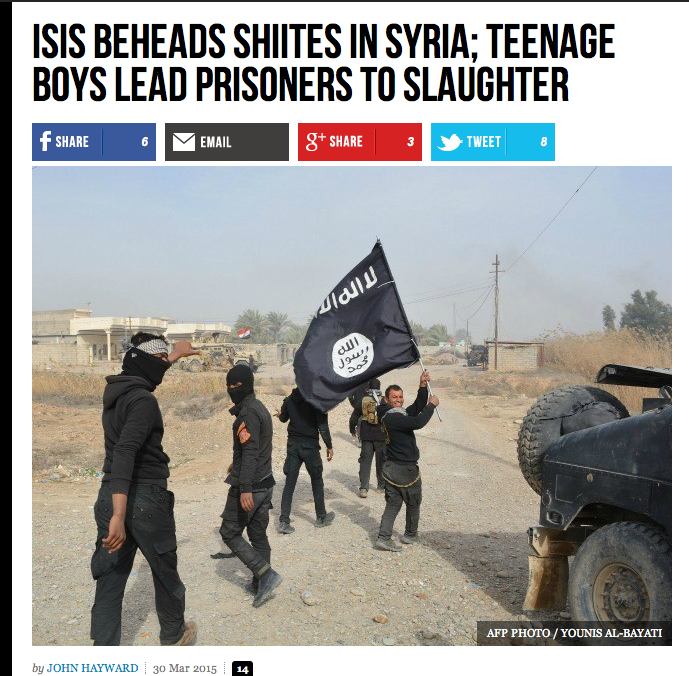
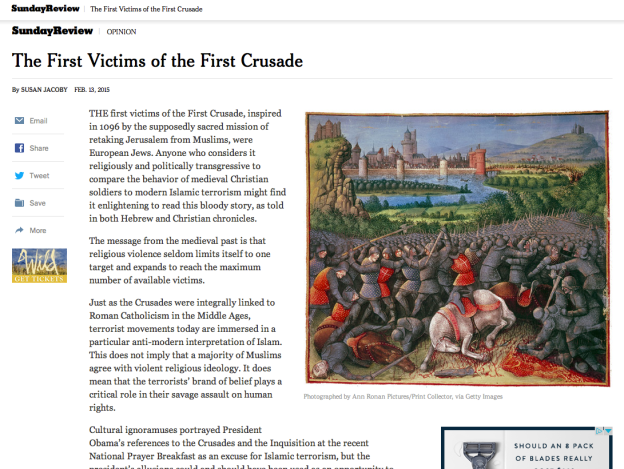
In defense of President Obama, who had recently been criticized for his comparison of the medieval crusaders to modern Islamic terrorists (see my response here), the New York Times published an essay on Friday (“The First Victims of the First Crusade”) by Susan Jacoby. Her essay highlighted the brutal attack on Jews during the First Crusade and, once again, equated the crusaders with modern Islamic terrorists. She wrote, “Anyone who considers it religiously and politically transgressive to compare the behavior of medieval Christian soldiers to modern Islamic terrorism might find it enlightening to read this bloody story.” She then described the horrors of the slaughter and compared it with the killing of religious minorities recently carried out by ISIS in the Middle East.

Jacoby then ended her piece with an odd celebration of the virtues of the post-Enlightenment West. In it, she contrasted the medieval Christian past with the modern post-Enlightenment western world, arguing that groups like ISIS “offer a ghastly and ghostly reminder of what the Western world might look like had there never been religious reformations, the Enlightenment and, above all, the separation of church and state.”

Jacoby’s comments, particularly those contrasting the medieval and modern west, caused a stir among medieval historians, much of it negative.

Continue reading