Soldier, Scholar, Politician: An Interview with Dr. Wayne Bowen

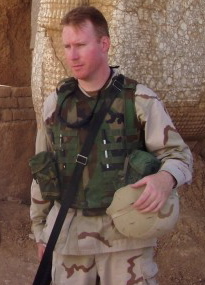
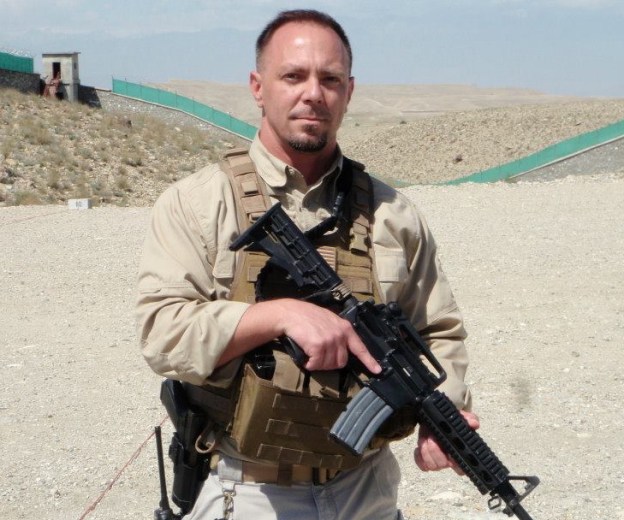
Although Dr. Wayne Bowen is an accomplished author, professor, and Chair of the Department of History at Southeast Missouri State University, he does not look or act like what one might expect from a history professor. He is physically fit, has close-cropped hair, and carries himself with an obvious military bearing, all of which is undoubtedly a product of his many years as an officer in the U.S. Army Reserve. Indeed, Wayne is a veteran of deployments to both Bosnia and Iraq, and has risen to the rank of Lt. Col. Perhaps equally as interesting, he has also recently embarked on a successful career as an elected politician, currently serving as a city councilman in his hometown of Cape Girardeau, Mo. Moreover, he has done so unapologetically as a Republican, which is a rarity among academics in the humanities.

OLYMPUS DIGITAL CAMERA

Continue reading

President Obama, ISIS, and the Crusades

Since President Obama’s controversial speech at the National Prayer Breakfast on Feb 5th, during which he compared the medieval crusades (as a form of religious extremism) with the religious extremism of modern terrorist groups like the ISIS, crusades historians have been busy writing a number of pieces that address the issue. Medieval historian Dan Franke has given a comprehensive overview (with links) of the various debates that have taken place. I’d suggest that those unfamiliar with these arguments and discussions start by reading his overview provided here.

Although a bit late to the party, I have also offered my two-cents on the issue in an guest column published by the Florida Times-Union. See Guest Column: Crusades were a Reaction to Islamic Militarism– Florida Times-Union.

A selection from that column is provided below.

——————-

“Significantly, it was in large part because of a period of heightened threat to Christians in the East during the late 11th Century that the First Crusade was called, as Muslim armies had recently conquered much of once Christian Anatolia.

For more than 20 years, Byzantine emperors had been requesting (and sometimes pleading for) military aid from Western Christians until they finally received it in the form of the First Crusade as called by Pope Urban II in 1095.

As retired Cambridge University historian Jonathan Riley-Smith once noted, “The denigrators of the crusades stress their brutality and savagery, which cannot be denied; but they offer no explanation other than the stupidity, barbarism and intolerance of the crusaders, on whom it has become conventional to lay most blame. Yet the original justification for crusading was Muslim aggression…”

This brings us back to Obama’s comments. I found them problematic for reasons cited by Riley-Smith.

The president told critics of modern Islamic violence to get off their “high horse” by citing the crusades as an example of similar Christian violence. Paradoxically the crusades were largely the product of medieval Islamic violence.”

——————-

Edit: Dan Franke continues to keep us updated on the current debate taking place online and in print. Here he links to the most recent articles, including my own, and even an online discussion I had the other night with two medieval historians, David Perry and Paul Halsall, about some of these issues. See Dan’s addendum here and my exchange (on David Perry’s website) with David and Paul here.
The Burning of the Jordanian Pilot and the Legitimacy of the Islamic State’s Caliphate

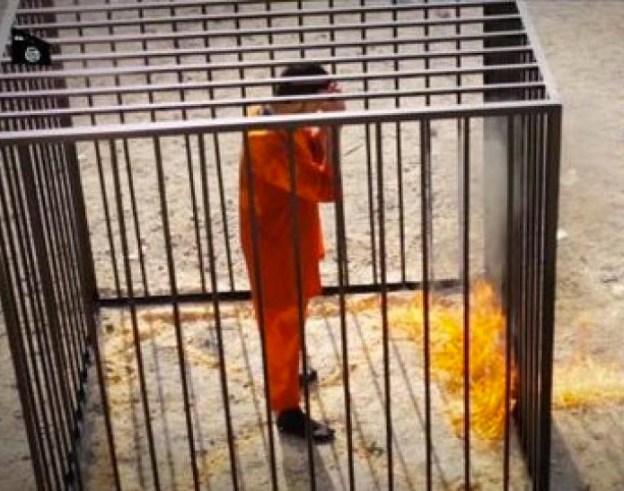
Last Tuesday the Islamic State released a video of their execution of a captured 26-year-old Jordanian pilot. In the gruesome video, they placed the young man in a cage, then lit an accelerant that quickly engulfed him in flames, burning him alive until he was dead. This was brutal even by Islamic State standards, which otherwise regularly beheads its enemies and recently attempted to execute a homosexual by throwing him off of a seven-story building. When they realized the man had survived the fall, they stoned him to death. Yet none of these gruesome executions generated as much condemnation as the video of the young pilot being burned to death.

Condemnation in the West was swift and furious, but it was perhaps even more pronounced in many parts of the Islamic world, as Muslim political and religious leaders condemned the execution as well. Such condemnations ranged from respected and influential Islamic authorities like the Grand Sheikh of Al-Azhar, Ahmed al-Tayeb, to radical and militant leaders from Al Qaeda and the Muslim Brotherhood, who compete with the Islamic State for recruits and legitimacy. See here, here, and here.

Yet the primary stated reason for the intensity of such condemnations had little to do with the death of the pilot, but rather the means by which the pilot died- fire. Continue reading

Will the Real Extremists Stand Up Please?

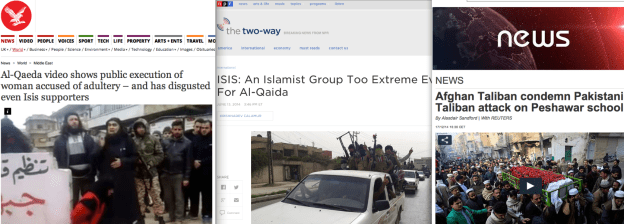
Recently an article in the U.K. Independent came out with the headline “Al-Qaeda video shows public execution of woman accused of adultery – and has disgusted even Isis supporters.”

Previously, it was widely reported that one of the reasons ISIS developed independently from Al-Qaeda was that even Al-Qaeda saw their methods as too extreme– causing division.

Now ISIS is taking shots at Al Qaeda suggesting their methods are too extreme (in this case over something that is relatively minor compared to what ISIS has done).

Add to this the recent condemnation of the Pakistan version of the Taliban’s killing of 130 plus school children as too extreme by the Afghan version of the Taliban and it begins to get a bit ridiculous. Who knows what they all think of their fellow jihadists Boko Haram in Nigeria. They probably nit-pick about their mass killings and public executions as well.

Will the real extremists stand up please?

The fact is that they are all extreme, ruthless, and brutal in their methods of course, but perhaps this is a way to try to win points with potential jihadists looking to join an organization that provides the right fit for their extremism since they now have so many choices? With over 18,000 foreign fighters from all over the world drawn to ISIS’s wars in Iraq and Syria and who knows how many foreign recruits drawn to various Ai-Qaeda or Taliban manifestations around the Middle East and Africa, not to mention the apparent appeal of Boko Haram in Nigeria, recruiting must be very competitive in the jihadist world at the moment. This would all be great material for a Monty Python style sketch if the reality was not so serious.

Bill Maher and Mainstream Muslim Beliefs: A Brief Analysis of the Recent Pew Poll on the Issue of Apostasy.

During Bill Maher’s October 3, 2014 program Real Time (on HBO), he and his guest Sam Harris got into a now well-known and heated debate with actor Ben Affleck over mainstream views in the Islamic world. The way in which the debate was framed was whether or not Islamist radicals represent only a fringe movement within the Islamic world (Affleck’s view), or something more significant (Maher’s view). In this context, Maher and Affleck argued over whether or not Muslims, in general, hold what Maher described as “pernicious beliefs.”

affleck_maher

A specific belief Maher highlighted was that a majority of Muslims (all Muslims, not just “extremists” or “radicals”) would support killing someone who left Islam, to which Affleck responded:

“The people who would actually believe in that you murder someone if they leave Islam is not the majority of Muslims at all…”

Maher later responded:

“I can show you a Pew poll of Egyptians–they are not outliers in the Muslim world–that says like 90% of them believe death is the appropriate response to leaving the religion.”

Continue reading

Islam, Freedom of Speech, and the Right to Offend

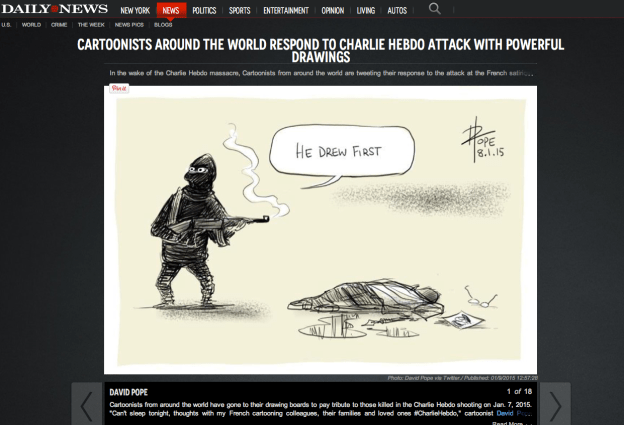
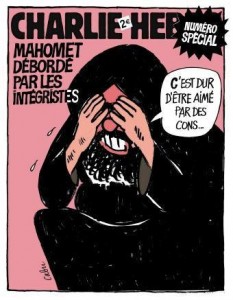
This week the world watched as a three day drama played out in France that began when Islamic militants slaughtered twelve people during an attack on the offices of the Paris based satirical magazine Charlie Hebdo. The magazine was well known for its satirical attacks on Christians, Jews, and French politicians, but had recently become a source of controversy for publishing cartoonish images of the Prophet Muhammad, which many Muslims viewed as both forbidden and offensive.

charlie-hebdo-mahomet-233x300Charlie-Hebdo-Muhammad-insult-230x300

A partial video of the Paris attack showed a particularly brutal moment when a wounded French police officer (a Muslim, no less), lying on the sidewalk, begged for his life as a terrorist coolly walked over to him and shot him in the head before they made their escape. A massive French manhunt began immediately afterwards, during which a supporter of the attackers took hostages at a Kosher market and threatened to kill them all if the police did not back off. Ultimately, it all ended in the killing of three militants, who refused to give up, and an ongoing hunt for the wife and accomplice of the hostage taker at the kosher market. By the time the terrorists were done, they had claimed the lives of at least sixteen French victims.

This followed in the wake of well-publicized Islamist attacks in western nations against police officers in New York City, soldiers in Canada, and café patrons in Australia. Dozens of other terrorist attacks took place around the world during the time of the French crisis, including, most notably, the slaughter of over 2000 people by the Islamist group Boko Haram in a series of deadly attacks on a Nigerian city and surrounding towns. Although this was far deadlier than the events that took place in France, it received relatively little attention in western media. In part, the reason for this was due to the unique reasons for the attack on Charlie Hebdo. While the militants of Boko Haram are trying, like ISIS in Iraq and Syria, to establish an Islamic caliphate, the attacks in Paris, more specifically, are seen as an attack on the western ideal of freedom of speech.

Continue reading

Medieval Warfare, The First Crusade, and Rape: Lessons for the Present?

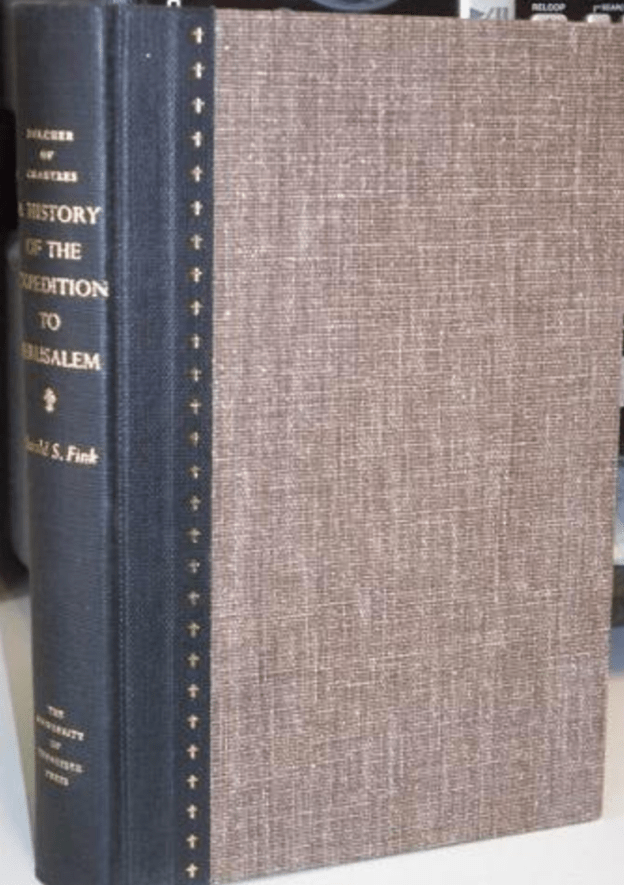
Above Image: Francis Rita Ryan’s translation of Fulcher (Fulk) of Chartres A History of the Expedition to Jerusalem- 1095-1127 (University of Tennessee Press, Knoxville, 1969).

—————

On January 3, 2015, I had the chance to present a paper for the Society for Medieval Feminist Scholarship at the annual meeting of the American Historical Association in New York City. I am presenting the basic text of my talk below. Anyone familiar with the dynamics of presenting papers at academic conferences will realize this is a very condensed overview of my broader consideration of the topic.

My paper was titled “Rape and the First Crusade.” It considers the oddity of the First Crusade as it related to the issue. While the wartime rape of captured women (and sometimes men) was common by all medieval armies, Christian or Islamic, the participants of the First Crusade generally seem to have avoided the practice. Indeed, the sources, whether friendly or hostile to the crusaders, seem to agree on the issue. This presentation pulls together some disconnected themes already considered by other historians into a broader and more comprehensive narrative to argue that the theoretical framework of the First Crusade contributed to a new mentality among warriors by which they sought to avoid sexual immorality, including rape, if they were to be successful on the battlefield.

This seems worthwhile to post here because the wartime rape of captive women continues to be a major problem today. One need only consider events in Rwanda and the Balkans in the 1990s, or more recent events with Boko Haram in Nigeria or ISIS in Iraq over the past few months. See my recent blog post on the issue here. What is most interesting about the First Crusade (as it relates to this topic) is that this potentially represents a case in which a theological framework for warfare seems to have, at the least, diminished instances of rape by otherwise violent warriors who had become accustomed to such practices prior to the First Crusade. If medieval Christian clerics could find a way to curtail, if not eliminate, such a brutal practice by Christian warriors in their day, then perhaps there is some small kernel of value in studying this for dealing with similar problems in the present.

yaz Boko

Continue reading

ISIS and Medievalism: An Interview with Dr. Sharan Newman

ISIS and Medievalism – An Interview with Dr. Sharan Newman

Since the events of September 11, 2001, westerners (in general) have been much more focused on the Islamic world than before. The “war on terror” that followed over the next decade, much of which was centered around the wars in Afghanistan and Iraq, became an all consuming focus of western media during that time. Almost everyone had some sort of personal connection to the war, whether through a relative, friend, or neighbor that served in Afghanistan or Iraq. Consequently, through their personal associations and almost non-stop media coverage, Americans and other westerners became far more interested in events in the Middle East and elsewhere as they tried to make sense of not only the violence of 9/11, but also the wars themselves and the extraordinary number of Islamist terrorist attacks that took place during this period. For some, it seemed Samuel Huntington’s so-called “Clash of Civilizations” was playing out in a clear and observable way.

Naturally, the scholarly community in the west has paid considerable attention to these events as well. They are a curious bunch and generally tend to pay a higher degree of attention to current events than most people, regardless of their disciplines. In this case, how could they not? Historians, political scientists, scholars of religion, and many others have devoted their lives to the study of topics related to the events of the last thirteen years.

In particular, the expertise of medieval historians, who otherwise tend to work on relatively obscure topics that few people see as relevant for the modern age, have suddenly seen their opinions and research find a newfound relevance for the modern world. Continue reading

Blackwater vs. ISIS? An Interview with Patrick Minor

Blackwater vs. ISIS? An Interview with Patrick Minor.

In response to the challenges posed by the rise of ISIS in Syria and Iraq, President Obama developed a plan that involved a coalition of European and Arab states that provided air-support to localized forces that resisted ISIS, including Kurds, a reconstituted Iraqi Army, tribal militias, and Syrian rebels. This patchwork of often poorly trained or poorly equipped ground troops, although having occasional success, has so far done relatively little to turn back ISIS’ gains. ISIS still controls, for example, lands between Syria and Iraq that cover a greater amount of territory than Britain. It also continues to engage multiple opponents on multiple fronts while drawing enthusiastic recruits from all over the world.

Rather than depending solely on a hastily constructed alliance of Kurds, Syrian rebels, and Iraqi soldiers, Eric Prince, the founder of the controversial Blackwater security group, had another suggestion. Prince, whose company had sent thousands of experienced, well trained, well equipped, and well paid fighters into Iraq and Afghanistan, suggested such forces could be used in the fight against ISIS as well.

Continue reading

An Interview with Dr. Florin Curta on Communism, Faith, and Academia

Dr. Florin Curta, Professor of History and Archaeology at the University of Florida, is one of the leading medieval historians in the world. His language capabilities, which include a reading knowledge of no less than eleven languages (including some he does not bother to list on his C.V.), are rarely matched even among academics. Moreover, his ten books, many on very complex historical issues, have consistently received positive reviews from his fellow historians with one winning the American Historical Associations’ Herbert Baxter Adams Prize in 2003. See links to his C.V. and publications here.

Florin1Florin2Florin3Florin4Florin6Florin5

Yet while his academic background is exceptional, his personal background is (at least) equally fascinating. Dr. Curta grew up in Romania while it was under communist rule. As a young man he was drafted into the Romanian army where he served as a paratrooper. Once he was done jumping out of perfectly good airplanes with a rifle strapped to his back, he pursued his education in Romania as both a historian and archaeologist. One could suggest, only half jokingly, that he was the original Indiana Jones. Continue reading